
How to Calculate Customer Acquisition Cost (CAC): Formula, Examples & Tips
Every business spends money to attract new customers, but do you know how much it actually costs to acquire one? Whether you run an online store, a marketing agency, a SaaS company, or a small business, understanding your customer acquisition cost (CAC) helps you measure how efficiently you turn marketing and sales investments into paying customers.
Learning how to calculate customer acquisition cost is important because spending more on advertising does not always mean acquiring more profitable customers. You might generate hundreds of leads through paid campaigns, but if only a small percentage become paying customers, your acquisition costs could be higher than expected.
The good news is that CAC is relatively simple to calculate. You only need your total sales and marketing expenses and the number of new customers acquired during the same measurement period.
In this guide, you’ll learn the customer acquisition cost formula, which expenses to include, how to calculate CAC step by step, and how to determine whether your business is spending too much to attract new customers.
What Is Customer Acquisition Cost (CAC)?

Customer acquisition cost (CAC) is the average amount of money a business spends to gain one new paying customer. It measures the combined cost of sales and marketing activities used to attract potential buyers and convert them into customers.
For example, imagine an online business spends $5,000 on advertising, marketing tools, and sales activities in one month. During that month, it gains 100 new customers.
Its average customer acquisition cost is $50 per customer.
Businesses use CAC to understand whether their marketing and sales investments are producing enough new customers to justify the expense.
This metric is particularly useful for:
- Small businesses: Understand how much money is required to attract each new buyer.
- Ecommerce stores: Measure the cost of acquiring first-time customers through advertising and promotions.
- SaaS companies: Evaluate the cost of converting free users and prospects into paying subscribers.
- Marketing agencies: Measure the efficiency of campaigns and customer acquisition strategies.
- B2B companies: Understand the cost of winning new accounts through sales teams and marketing activities.
A low CAC can indicate efficient customer acquisition, but it does not automatically mean a business is profitable. You also need to consider customer revenue, profit margins, and retention.
Also Read : Why Is My Marketing Not Working? 10 Reasons and How to Fix Them
How to Calculate Customer Acquisition Cost

The basic customer acquisition cost calculation requires two things: your total acquisition expenses and the number of new customers you gained during a specific period.
Customer Acquisition Cost Formula
The standard formula is:
CAC = Total Sales and Marketing Costs ÷ Number of New Customers Acquired
You can also express it as:
[
CAC = \frac{\text{Marketing Costs + Sales Costs}}{\text{New Customers}}
]
For example, suppose your business spends $8,000 on marketing and $2,000 on sales activities during one month. You acquire 200 new customers during that period.
Your calculation would be:
[
CAC = \frac{$8,000+$2,000}{200}
]
[
CAC = \frac{$10,000}{200} = $50
]
Your customer acquisition cost is $50 per new customer.
This means your business spends an average of $50 in sales and marketing expenses to acquire each new buyer.
Step 1: Choose a Measurement Period
Before calculating CAC, decide which period you want to evaluate.
Most businesses calculate customer acquisition cost monthly, quarterly, or annually. The right choice depends on how frequently your company acquires customers and how long its sales process takes.
For example:
- Monthly: Useful for ecommerce stores and businesses running frequent advertising campaigns.
- Quarterly: Helpful for businesses with longer sales cycles or changing marketing budgets.
- Annually: Useful for understanding long-term acquisition trends and overall business performance.
Try to use a consistent measurement period when comparing results.
One important consideration is the sales cycle. If your marketing activities generate leads in January but those leads become paying customers in March, comparing January’s expenses with January’s customer count may produce a misleading result.
For businesses with longer sales cycles, use consistent attribution rules and allow enough time for campaigns to generate conversions.
Step 2: Calculate Your Total Marketing Expenses
Next, add up the marketing expenses associated with acquiring new customers during your chosen period.
These expenses can include:
- Google Ads, Facebook Ads, and other paid advertising campaigns.
- Influencer marketing and sponsorships.
- Content creation, including blog articles, videos, and graphics.
- SEO and social media marketing.
- Email marketing campaigns.
- Marketing agency and freelancer fees.
- Marketing software and automation tools.
- Promotional campaigns and first-time customer discounts.
For example, imagine your monthly marketing expenses look like this:
- Paid advertising: $3,000
- Content creation: $800
- SEO services: $500
- Marketing software: $200
- Influencer campaigns: $500
Your total marketing expenses are $5,000.
Include only the portion of shared expenses that reasonably supports customer acquisition. Avoid counting the same expense twice.
Step 3: Add Your Sales Expenses
Marketing attracts potential customers, while sales activities help convert prospects into paying buyers.
Depending on your business model, sales expenses may include:
- Sales team salaries and commissions.
- Employee bonuses related to new customer acquisition.
- Sales training and recruitment costs.
- CRM and sales management software.
- Sales travel and client meetings.
- Agency or contractor fees for sales activities.
- Other direct expenses involved in winning new customers.
Suppose your business spends another $2,000 on sales salaries, commissions, and sales tools.
Your combined acquisition expenses are now:
Marketing expenses = $5,000
Sales expenses = $2,000
Total acquisition expenses = $7,000.
For a more complete calculation, include the relevant portion of employee compensation and software costs rather than counting advertising expenses alone.
Step 4: Count Your New Customers
Now determine how many first-time customers your business acquired during the same period.
You can find this information through your ecommerce dashboard, CRM, billing system, or customer database.
For example, if your business received 500 orders in a month, but only 300 came from first-time buyers, your new customer count is 300.
Do not automatically count every order as a new customer.
Returning customers, repeat purchases, existing subscribers, and existing accounts should generally be excluded from a standard new-customer CAC calculation.
For subscription businesses, count customers when they become paying customers according to your chosen acquisition definition. Free trial registrations and email sign-ups are not necessarily paying customer acquisitions.
Consistency is important because changing your counting method can make CAC comparisons unreliable.
Step 5: Divide Total Expenses by New Customers
Once you have calculated your total sales and marketing expenses and identified the number of new customers, apply the CAC formula.
Suppose your business has:
- Total marketing expenses: $5,000
- Total sales expenses: $2,000
- New customers acquired: 140
Your calculation is:
[
CAC = \frac{$5,000+$2,000}{140}
]
[
CAC = \frac{$7,000}{140} = $50
]
Your customer acquisition cost is $50.
You can repeat this calculation every month or quarter to understand whether your business is becoming more or less efficient at acquiring customers.
Customer Acquisition Cost Calculation Example
Let’s look at a more detailed example to understand how CAC works in a real business.
Imagine an online clothing store wants to calculate its customer acquisition cost for one quarter. During those three months, the company invests in advertising, content creation, marketing software, and sales activities.
Its expenses are:
| Expense | Quarterly Cost |
|---|---|
| Paid advertising | $12,000 |
| Content creation and SEO | $3,000 |
| Marketing software | $1,000 |
| Sales salaries and commissions | $6,000 |
| Agency and promotional expenses | $2,000 |
| Total acquisition cost | $24,000 |
During the same quarter, the store acquires 600 first-time customers.
Using the CAC formula:
[
CAC = \frac{$24,000}{600}
]
[
CAC = $40
]
The clothing store spends an average of $40 to acquire each new customer.
Now suppose the business wants to attract 200 additional customers next quarter while maintaining the same acquisition cost.
Its estimated acquisition budget would be:
[
200 \times $40 = $8,000
]
This gives the business a starting point for planning its marketing budget. However, actual spending may change if advertising costs, conversion rates, or customer demand change.
Blended CAC vs. Paid CAC: What’s the Difference?
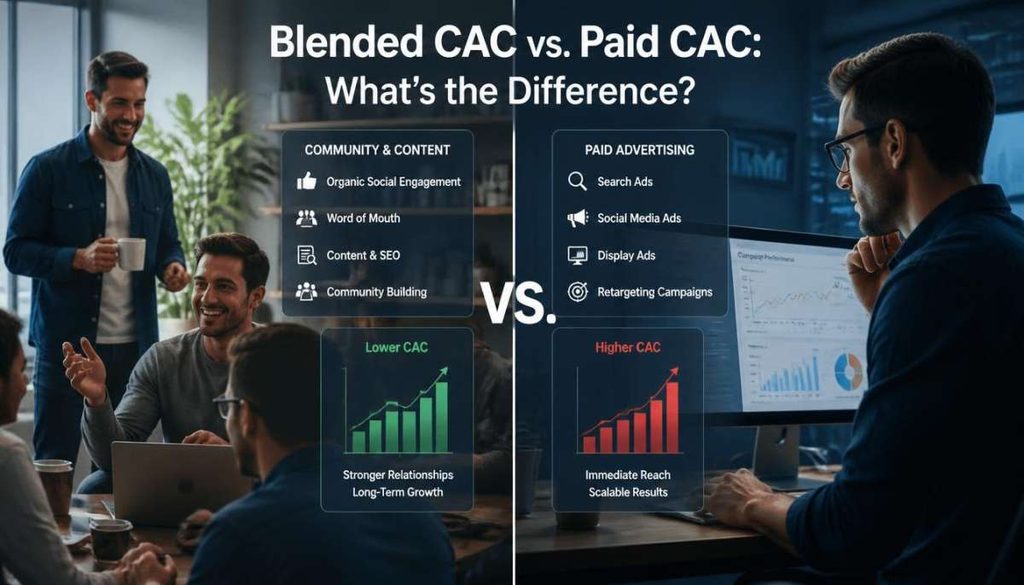
Not all customer acquisition cost calculations measure the same thing.
Two commonly used approaches are blended CAC and paid CAC. Understanding the difference helps businesses evaluate their overall acquisition efficiency and individual marketing channels.
Blended CAC measures the average acquisition cost across all relevant channels. It includes both paid and non-paid acquisition activities, along with the associated sales and marketing expenses.
Paid CAC focuses on customers acquired through paid marketing channels, such as Google Ads, Facebook Ads, and sponsored campaigns. It divides the relevant paid acquisition expenses by the new customers attributed to those channels.
For example, suppose a company spends $10,000 across its sales and marketing activities and gains 200 new customers from all channels.
Its blended CAC is $50.
However, if it spends $4,000 on paid advertising and acquires 80 customers attributed to those campaigns, its paid CAC is $50.
Both calculations are correct, but they answer different questions. Blended CAC shows overall acquisition efficiency, while paid CAC helps evaluate paid advertising performance.
When calculating channel-specific CAC, use a consistent attribution method and avoid dividing one channel’s advertising spend by customers acquired through unrelated channels.
What Is a Good Customer Acquisition Cost?
There is no single customer acquisition cost that is considered good for every business.
A $20 CAC might be expensive for a company selling inexpensive products but very affordable for a business selling high-value services or long-term subscriptions.
Several factors influence what an acceptable CAC looks like:
- Product pricing: Businesses selling expensive products may be able to support higher acquisition costs.
- Profit margins: Companies with higher margins generally have more room to invest in acquiring customers.
- Customer retention: Customers who continue purchasing over time may generate enough revenue to justify a higher initial CAC.
- Industry competition: Competitive markets can increase advertising and sales expenses.
- Sales cycle: Businesses with longer sales processes may need to invest more before winning a customer.
Rather than comparing your CAC with an unrelated business, evaluate it against your customer lifetime value, gross margin, and acquisition payback period.
How Customer Lifetime Value Affects CAC
Customer lifetime value (LTV), sometimes called CLV, estimates the total value or revenue a business expects to receive from a customer throughout their relationship.
Comparing LTV with CAC helps determine whether the amount spent acquiring customers is justified by the value they generate.
A commonly discussed SaaS benchmark is an LTV-to-CAC ratio of 3:1. However, this is a general reference point rather than a universal rule. Your ideal ratio depends on your business model, gross margins, retention, and cash flow.
For example:
- Customer lifetime value: $900
- Customer acquisition cost: $300
[
LTV:CAC = \frac{$900}{$300}=3:1
]
This means the estimated customer lifetime value is three times the acquisition cost.
Remember that LTV should ideally be calculated using gross profit rather than revenue when assessing acquisition economics. Otherwise, the comparison may overstate how much value the customer actually generates for your business.
How to Reduce Customer Acquisition Cost: 5 Practical Tips

Calculating CAC is only useful if you apply the results to improve your business. If your acquisition costs are increasing, review your marketing and sales processes to identify where money is being wasted.
Here are five practical ways to improve acquisition efficiency.
1. Improve Your Marketing Conversion Rate
Getting more visitors is not always the best way to acquire customers. Sometimes, improving the percentage of visitors who become buyers can reduce your acquisition costs without increasing your advertising budget.
Review your landing pages, product descriptions, checkout process, and calls to action.
Make sure potential customers can quickly understand what you offer and why it is worth purchasing.
Even small improvements in conversion rates can help you acquire more customers from the same marketing investment.
2. Focus on Your Most Profitable Marketing Channels
Not every marketing channel delivers the same results.
One advertising campaign may generate hundreds of clicks but very few purchases, while another may bring fewer visitors who are more likely to become paying customers.
Track the performance of your marketing channels separately.
Compare the number of new customers, acquisition expenses, conversion rates, and customer value associated with each channel.
Invest more carefully in channels that attract customers who remain profitable over time.
3. Use Customer Referrals
Existing customers can become an important source of new business.
A referral program encourages satisfied customers to recommend your products or services to friends, family, and colleagues.
You might offer discounts, loyalty points, account credits, or other appropriate rewards for successful referrals.
However, include referral incentives and program expenses when calculating acquisition costs. A referral is not automatically free just because it comes from an existing customer.
4. Improve Customer Retention
Customer retention and customer acquisition are different activities, but they influence overall business profitability.
When customers continue buying from your business, you can generate more value from the original acquisition investment.
Focus on providing helpful customer support, delivering consistent product quality, and maintaining communication after a purchase.
For subscription businesses, reducing cancellations can improve the lifetime value of customers and make existing acquisition spending more worthwhile.
5. Use Data to Improve Your Sales and Marketing Strategy
Guessing where to spend your marketing budget can lead to unnecessary expenses.
Use analytics platforms, advertising dashboards, and CRM systems to understand how customers discover your business and what eventually convinces them to purchase.
Review your acquisition performance regularly and identify campaigns that generate low-quality leads or poor conversions.
Also, make sure your marketing and sales teams share accurate customer information. Better coordination can reduce wasted spending and help your business convert qualified prospects more efficiently.
Customer Acquisition Cost FAQs
What is the formula for customer acquisition cost?
The customer acquisition cost formula is total sales and marketing expenses divided by the number of new customers acquired during the same period.
CAC = (Marketing Costs + Sales Costs) ÷ New Customers Acquired.
For example, if your business spends $6,000 and acquires 120 new customers, your CAC is $50.
What is a CAC calculator?
A CAC calculator is a simple tool that helps businesses calculate their average customer acquisition cost. You enter your sales expenses, marketing expenses, and number of new customers. The calculator divides your combined acquisition expenses by the number of new customers to produce your CAC.
What is a good customer acquisition cost ratio?
There is no universal ideal CAC. However, a 3:1 LTV-to-CAC ratio is a commonly used reference point, particularly in SaaS businesses. This means the estimated customer lifetime value is three times the acquisition cost. The appropriate target depends on profitability, margins, retention, and cash flow.
How do you calculate customer acquisition cost for a SaaS business?
A SaaS company calculates CAC by adding its relevant sales and marketing expenses over a specific period and dividing the total by the number of new paying customers acquired during that period. Expenses may include advertising, content creation, sales salaries, commissions, CRM software, and marketing tools.
How does CAC differ from CPA?
Customer acquisition cost measures the average cost of acquiring a new paying customer, while cost per acquisition (CPA) often measures the cost of generating a particular action, such as a lead, registration, download, or purchase. CAC generally considers a broader range of sales and marketing expenses.
Should existing customers be included when calculating CAC?
No. Standard new-customer CAC calculations count first-time customers rather than repeat purchases from existing customers. If you include returning customers, you may make your acquisition costs appear lower than they actually are.
Why is customer acquisition cost important?
CAC helps businesses understand how efficiently they spend money to attract new customers. It supports marketing budget decisions, profitability analysis, channel comparisons, and long-term growth planning.
Make Better Business Decisions With Your CAC
Understanding how to calculate customer acquisition cost gives you a clearer picture of what it takes to grow your business. By tracking sales and marketing expenses, counting first-time customers, and applying the CAC formula consistently, you can measure how efficiently your company attracts new buyers.
However, don’t focus on lowering CAC at any cost. Spending less to acquire customers is only beneficial when customer quality, retention, and profitability remain healthy.
Compare CAC with customer lifetime value, monitor individual marketing channels, and regularly review your sales and marketing expenses. These steps can help you make more informed investment decisions and build a sustainable customer acquisition strategy.