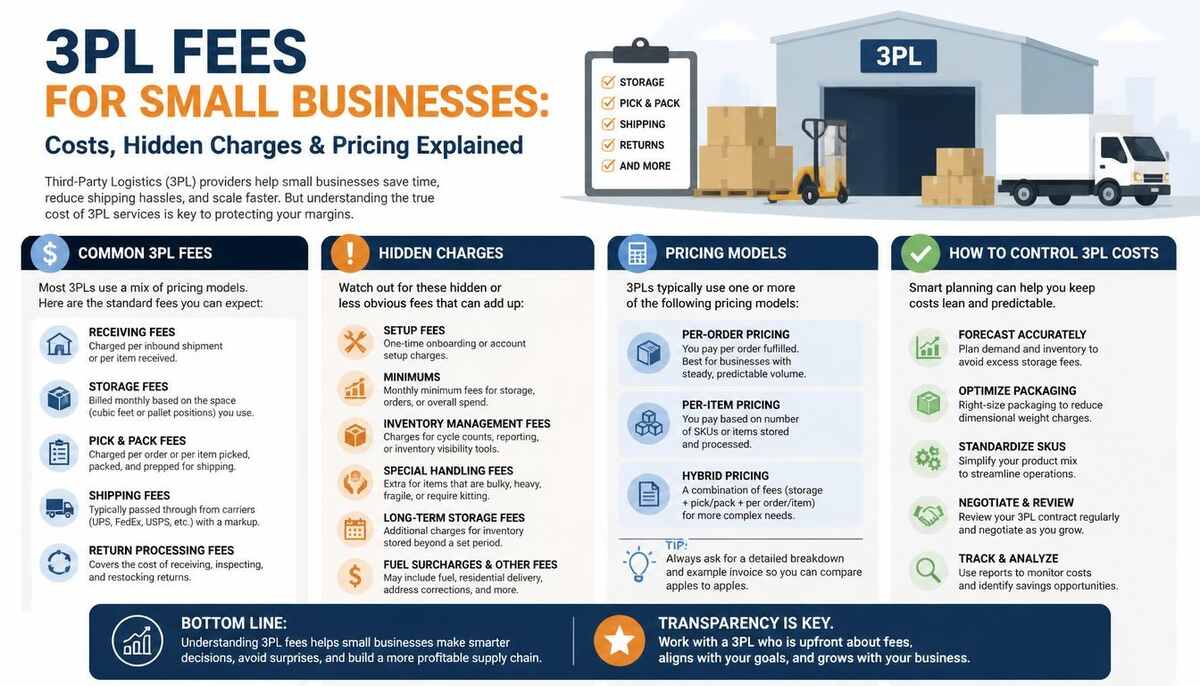
3PL Fees for Small Businesses: Costs, Hidden Charges & Pricing Explained
Choosing a third-party logistics provider can help a small business store inventory, process customer orders, and ship products without managing its own warehouse. But understanding the actual cost is not always straightforward.
A 3PL provider may advertise an attractive pick-and-pack rate while charging separately for receiving inventory, storage, packaging, shipping, returns, and account management. These additional charges can make the final monthly invoice very different from the initial quote.
For a small ecommerce business, the important question is not simply how much a 3PL charges per order. It is how much the complete fulfillment process costs after every applicable fee is included.
This guide explains common 3PL fees, US pricing benchmarks, hidden charges to watch for, and a practical example of calculating monthly fulfillment expenses. You will also learn how to compare two providers before signing a contract.
What Are 3PL Fees?
Third-party logistics (3PL) fees are the charges a business pays an external logistics provider to handle some or all of its fulfillment operations.
Depending on the agreement, a 3PL may receive your inventory, store products in its warehouse, process customer orders, pack shipments, arrange delivery, and handle returned products.
Instead of managing these activities yourself, you pay the provider according to its pricing structure.
Common 3PL services include:
- Receiving: Accepting and checking incoming inventory.
- Storage: Keeping products in warehouse space until they are needed.
- Pick and pack: Selecting products from inventory and preparing customer orders.
- Packaging: Supplying boxes, mailers, labels, and protective materials.
- Shipping: Arranging transportation through parcel carriers.
- Returns processing: Receiving returned products and updating inventory.
- Additional services: Kitting, labeling, custom packaging, and special handling.
Not every 3PL includes all these services in its base price. Some providers bundle several activities together, while others charge separately for each one.
That is why you should review the complete fee schedule rather than comparing only the advertised fulfillment rate.
How Much Does a 3PL Cost for a Small Business?
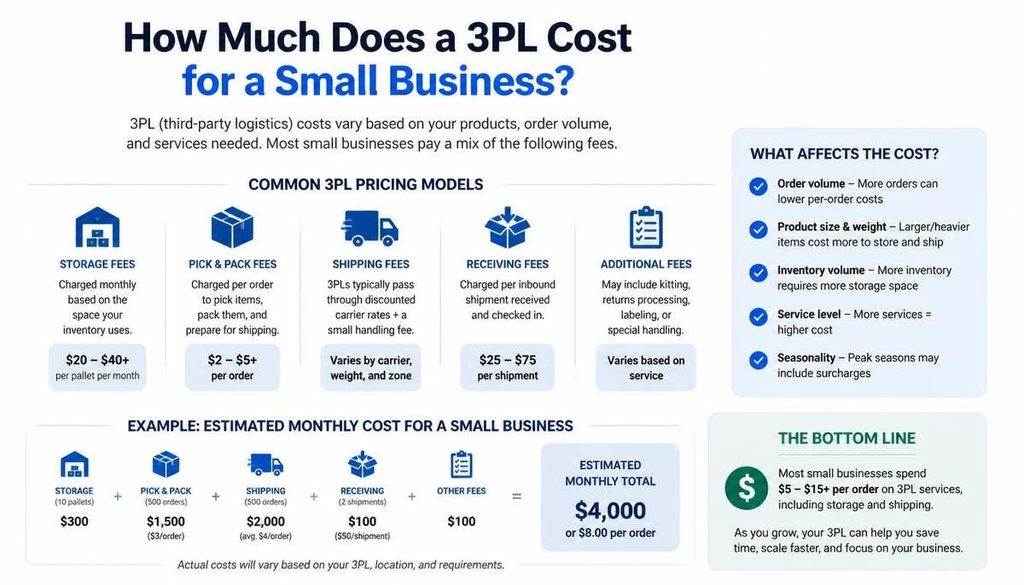
There is no single price that applies to every small business. The total depends on order volume, product dimensions, average items per order, inventory levels, warehouse location, shipping destinations, and the services included in the contract.
A November 2026 US 3PL Price Index examined publicly listed rates from 66 providers that published pricing on their websites. Its reported median figures included:
| Service | Published median |
|---|---|
| Pick and pack | $2.00 per order |
| Additional item pick | $0.50 per item |
| Pallet storage | $25 per pallet per month |
| Receiving | $18 per pallet |
| Monthly minimum | $397 |
These figures represent published rates from providers that disclosed pricing, not every 3PL in the market. The monthly minimum median also comes from a smaller group of providers that disclosed a dollar amount.
A separate survey of more than 600 warehouses, reported in a 2026 pricing guide by Fulfill.com, found an average B2C pick-and-pack charge of approximately $3.20 for a one-item order and average pallet storage of $20.17 per month.
These figures come from a different dataset and should not be treated as directly interchangeable with the published-rate medians above.
Source: Fulfill.com – 3PL Pricing in 2026.
The difference between these figures illustrates an important point: survey averages, public rate-card prices, and negotiated customer quotes measure different things.
Use benchmarks as a starting point for evaluating offers, not as a promise of what a provider will charge your business.
Fulfillment expenses also affect how much cash your business needs to keep available for everyday operations. Storage bills, receiving charges, and shipping expenses can create additional pressure when sales fluctuate. If you are planning these expenses alongside other operating costs, read our guide on managing cash flow in a small business.
Breakdown of Common 3PL Fees
Understanding each fee makes it easier to identify what is included in a quote and what may appear separately on your invoice.
1. Setup and Onboarding Fees
Some 3PL providers charge an initial fee when a new customer joins.
This may cover account configuration, inventory system setup, warehouse procedures, staff onboarding, and integration with an ecommerce platform.
Ask whether the setup fee is charged once or repeated when you add another sales channel, warehouse, or special service.
You should also ask whether the provider charges separately for connecting platforms such as Shopify, WooCommerce, or Amazon.
2. Receiving and Inventory Intake Fees
Receiving fees cover the work involved when your products arrive at a 3PL warehouse.
Depending on the provider, charges may be calculated per pallet, carton, unit, container, or hour of labor.
For example, a provider may charge one amount to unload a pallet but a different amount to count individual products, inspect stock, apply labels, and record inventory in its system.
Before accepting a quote, ask:
- Is receiving charged per pallet, carton, or individual unit?
- Does the price include counting and inspection?
- Are labeling and barcode services included?
- Are floor-loaded containers charged separately?
- What happens when inventory arrives without proper labels?
A low receiving rate may not be particularly useful if additional inventory preparation charges make the complete process expensive.
3. Monthly Storage Fees
Storage fees cover the warehouse space occupied by your products.
Common pricing methods include:
- Per pallet per month.
- Per bin per month.
- Per cubic foot per month.
- Per shelf or storage location.
- Per square foot of warehouse space.
Pallet storage can work well for businesses with larger quantities of inventory, while bin-based pricing may suit smaller products.
The important detail is how the provider calculates occupied space.
For example, does it charge for a full pallet even when your inventory occupies only part of the pallet? Does storage pricing change during peak seasons? Is there a separate charge for slow-moving inventory?
Ask for these details in writing before sending your stock to the warehouse.
4. Pick and Pack Fees
Pick-and-pack fees cover selecting products from warehouse inventory and preparing them for shipment.
A typical charge may include:
- Processing the customer order.
- Picking the first item.
- Packing the item.
- Preparing the shipment for dispatch.
However, not every provider includes the same activities.
Some charge a base order fee and then add a separate amount for every additional item. Others include the first pick but charge separately for packaging materials.
Consider a store that receives 500 orders in one month. If its provider charges $2 per order for the first item, the basic pick fee would be:
500 × $2 = $1,000
If customers order multiple products, additional-item charges must also be included.
Always check whether the advertised price includes the first item, every item, or only the order-processing activity.
5. Packaging Material Fees
Boxes, mailers, tape, labels, inserts, and protective packaging may be included in a fulfillment package or charged separately.
Custom-branded packaging can cost more than standard warehouse materials.
Ask your provider:
- Are standard boxes included?
- Are shipping labels billed separately?
- Is there an additional charge for branded packaging?
- Are bubble wrap and protective inserts included?
- Can you supply your own packaging materials?
If your products require fragile-item protection or special presentation, make sure the quote reflects those requirements.
6. Shipping and Carrier Charges
Shipping is often one of the largest parts of an ecommerce fulfillment bill.
A 3PL may purchase carrier services on your behalf and pass the charges to you. Some providers offer negotiated shipping rates, while others apply a markup or charge an administration fee.
Your shipping cost may depend on:
- Package weight.
- Package dimensions.
- Delivery destination.
- Shipping speed.
- Carrier selection.
- Residential delivery or other applicable surcharges.
- Fuel and peak-season adjustments.
Dimensional weight is especially important. A large, lightweight package can cost more to ship than its actual weight might suggest.
Ask whether the provider passes through carrier rates, applies a markup, or uses a bundled shipping price.
Do not compare one provider’s pick-and-pack fee with another provider’s all-in order price. The two figures may include completely different services.
7. Returns Processing Fees
When a customer sends a product back, the 3PL may charge to receive the parcel, inspect the item, update inventory, and prepare the product for resale.
Some providers charge per return, while others add fees for individual inspection or restocking activities.
Ask what happens when a returned product is damaged, missing its original packaging, or cannot be resold.
You should also check whether the provider handles return labels and customer-facing return requests or only processes the physical product after it arrives.
8. Monthly Minimum and Account Management Fees
A monthly minimum is the lowest amount a provider expects to collect for certain services during a billing period.
For example, imagine a contract with a $400 monthly minimum for fulfillment services. If eligible charges total only $250, the provider may bill the minimum instead.
The exact treatment depends on the agreement. Some contracts apply the minimum to pick-and-pack charges only, while others define a broader group of eligible services.
Account management fees may also apply when the provider assigns dedicated support or performs additional administrative work.
Ask which services count toward the monthly minimum and whether account management is included in it.
Hidden 3PL Fees Small Businesses Should Watch For
A quote can appear affordable because it highlights only the most attractive part of the service. The complete contract may contain additional charges that are easy to overlook.
Here are some areas worth checking.
| Potential charge | What to clarify |
|---|---|
| Long-term storage | When does the surcharge begin? |
| Inventory recount | Is there a fee for cycle counts or investigations? |
| Relabeling | What is the per-unit charge? |
| Special handling | Are fragile or oversized products billed differently? |
| Kitting and bundling | Is pricing per kit, item, or labor hour? |
| Peak-season surcharge | When does it apply and how is it calculated? |
| Returns inspection | Is inspection included in the return fee? |
| Account management | Is there a recurring support charge? |
| Monthly minimum | Which services count toward the minimum? |
| Contract termination | Are there exit, removal, or inventory-transfer charges? |
The best way to avoid unexpected expenses is to request a complete rate card before signing.
Do not rely only on a sales representative’s verbal explanation. Ask for written confirmation of the charges, billing units, and conditions under which additional fees apply.
How to Calculate Your Monthly 3PL Cost
To understand whether a provider is affordable, calculate the complete monthly cost instead of focusing on a single fee.
A practical formula is:
Monthly 3PL Cost = Receiving + Storage + Pick and Pack + Packaging + Shipping + Returns + Other Applicable Fees
If your contract has a monthly minimum, check whether it acts as a floor for eligible charges rather than an additional fee automatically added to every invoice.
You can also calculate the fulfillment cost per order:
Fulfillment Cost Per Order = Monthly Fulfillment Cost ÷ Number of Orders Shipped
For a meaningful comparison, keep postage separate if you are comparing fulfillment charges without shipping.
Example: 3PL Costs for a Small Business With 500 Monthly Orders
Imagine a small US ecommerce store that ships 500 orders per month.
For this hypothetical example, assume:
- 500 customer orders.
- 1.3 items per order on average.
- 20 pallets in monthly storage.
- 5 pallets received during the month.
- 20 customer returns.
- Packaging materials billed separately.
The example uses selected published pricing benchmarks where available and clearly identified assumptions for the other charges.
| Expense | Calculation | Monthly cost |
|---|---|---|
| First-item pick and pack | 500 × $2.00 | $1,000.00 |
| Additional item picks | 150 × $0.50 | $75.00 |
| Pallet storage | 20 × $25.00 | $500.00 |
| Receiving | 5 × $18.00 | $90.00 |
| Packaging assumption | 500 × $0.50 | $250.00 |
| Returns processing assumption | 20 × $4.06 | $81.20 |
| Estimated total | $1,996.20 |
The estimated fulfillment cost per shipped order is:
$1,996.20 ÷ 500 = $3.99 per order
This calculation excludes postage, setup fees, taxes, account management, and any other charges not listed in the example.
The $0.50 packaging allowance is a hypothetical assumption, not an industry average. The $4.06 returns figure comes from a separate warehouse survey benchmark reported by Fulfill.com.
The example is designed to show how different charges add up. It is not a provider quote or a guaranteed monthly bill.
One important lesson is that storage and additional-item charges can meaningfully change the final cost, even when the advertised first-item pick rate looks inexpensive.
Understanding fulfillment expenses is also part of managing your overall business pricing. If logistics costs affect your margins, review this guide on pricing your business services to better understand how operating expenses influence your pricing decisions.
How to Compare Two 3PL Quotes
Once you receive proposals from different providers, compare them using the same order volume, inventory requirements, packaging needs, and shipping assumptions.
Otherwise, you may end up comparing prices for different services.
Step 1: Standardize Your Order Volume
Give both providers the same estimated monthly order volume.
Include:
- Total monthly orders.
- Average items per order.
- Percentage of multi-item orders.
- Monthly returns.
- Average inventory levels.
- Expected inbound shipments.
A provider may offer a lower rate at higher order volumes, so make sure both quotes use the same volume assumptions.
Step 2: Compare Every Billing Unit
Check whether each service is billed per order, item, pallet, bin, carton, return, or hour.
A $2 order fee and a $2 first-item fee are not necessarily the same thing.
Make sure you understand exactly what the base charge includes.
Step 3: Separate Fulfillment From Postage
Request shipping costs separately whenever possible.
Ask whether the carrier charge is passed through directly, marked up, or bundled into the provider’s quoted price.
You should also ask how residential, remote-area, dimensional-weight, and peak-season surcharges are handled.
Step 4: Review Minimums and Additional Charges
Compare monthly minimums, account management, setup fees, inventory handling, and contract exit terms.
A provider with a low pick fee may still cost more if it has a high monthly minimum or several additional service charges.
Step 5: Request a Sample Invoice
Ask each provider to prepare a sample monthly invoice using your estimated order and inventory information.
This is one of the easiest ways to spot differences between the advertised rate and the amount you may actually pay.
Simple 3PL Quote Comparison Checklist
Before choosing a provider, check each item:
- First-item pick-and-pack charge.
- Additional-item pick charge.
- Storage billing method and rate.
- Receiving and inventory intake fees.
- Packaging material costs.
- Shipping rates and carrier markups.
- Returns processing charges.
- Monthly minimum and account fees.
- Peak-season and long-term storage surcharges.
- Contract length and termination conditions.
When Is a 3PL Worth It for a Small Business?
Outsourcing fulfillment can be useful when managing inventory, packing orders, and arranging shipping takes too much time away from other business activities.
However, using a 3PL does not automatically reduce costs.
A small store that ships only a few orders each week may find that self-fulfillment remains more economical. A growing store with consistent orders, limited warehouse space, and increasing operational demands may benefit from outsourcing.
Consider a 3PL when:
- Your order volume is growing consistently.
- You are spending too much time packing and shipping.
- Your current storage space is becoming insufficient.
- You want to reach customers in different regions.
- You need more organized inventory and fulfillment processes.
- You want to focus more time on product development and marketing.
Before deciding, compare the complete outsourcing cost with your current operating expenses.
Include warehouse rent, labor, packaging, shipping administration, software, equipment, and the time you spend managing fulfillment.
Also consider whether outsourcing will improve delivery performance and free up time for profitable activities.
If fulfillment is becoming a constraint on expansion, review your wider small business growth strategy before committing to a long-term logistics agreement.
Questions to Ask Before Signing a 3PL Contract
A good provider should be able to explain its pricing clearly.
Before signing, ask:
- What services are included in the base fulfillment rate?
- How are receiving and storage charges calculated?
- Is the first product pick included in the order fee?
- What is the price for every additional item?
- Are standard packaging materials included?
- How are shipping rates calculated and passed on to customers?
- Are there monthly minimums or account management charges?
- How are returns, damaged products, and inventory discrepancies handled?
- Are there seasonal, long-term storage, or special handling surcharges?
- What happens to my inventory if I decide to leave the provider?
Also ask for the current rate card, a sample invoice, and the contract’s price-adjustment terms.
A provider’s ability to explain these details is an important part of evaluating the service.
Frequently Asked Questions
How much does a 3PL charge per order?
The price depends on the provider, order size, and services included. The November 2026 US 3PL Price Index reported a $2 median published pick-and-pack rate per order among the providers that disclosed pricing. This does not include every possible fulfillment or shipping charge.
Do 3PL fees include shipping?
Not always. Many providers charge fulfillment fees separately from carrier postage. Some offer bundled rates, so check whether the quoted amount includes packaging, shipping labels, and transportation.
Do small businesses have to pay a monthly 3PL minimum?
Some providers require monthly minimum spending, while others do not publish or require a dollar minimum. Check the contract to see which charges count toward the minimum and what happens when your monthly activity falls below it.
How much does 3PL storage cost?
Storage depends on the warehouse, location, inventory volume, and billing method. The November 2026 published-rate index reported a $25 median per pallet per month among 22 providers with published pallet rates. Bin and cubic-foot storage are priced differently.
Is a 3PL cheaper than fulfilling orders yourself?
It depends on your order volume and current operating costs. Self-fulfillment may be more economical for a small number of orders, while outsourcing may become attractive when warehouse space, labor, and fulfillment management become significant expenses.
Can small businesses negotiate 3PL fees?
Yes, some providers may negotiate rates based on order volume, contract length, inventory requirements, and service needs. You can also ask about volume discounts, minimum commitments, and bundled services. Always compare the complete contract rather than negotiating only the pick-and-pack price.
What is the difference between fulfillment fees and shipping fees?
Fulfillment fees cover warehouse activities such as receiving, storage, picking, and packing. Shipping fees cover transporting the parcel from the warehouse to the customer. Some contracts bundle these costs, but many list them separately.
Final Thoughts
Choosing a 3PL provider is not just about finding the lowest advertised fulfillment rate. The real cost comes from the complete set of services your business needs, including receiving, storage, picking, packaging, shipping, and returns.
Start by estimating your monthly order volume and inventory requirements. Then request complete written quotes from multiple providers and compare them using the same assumptions.
Pay particular attention to monthly minimums, shipping markups, additional-item charges, and contract exit terms. A slightly higher base rate may still represent better value if it includes services that another provider bills separately.
The best 3PL arrangement is one that fits your current business size, makes fulfillment easier to manage, and supports growth without creating unexpected costs.