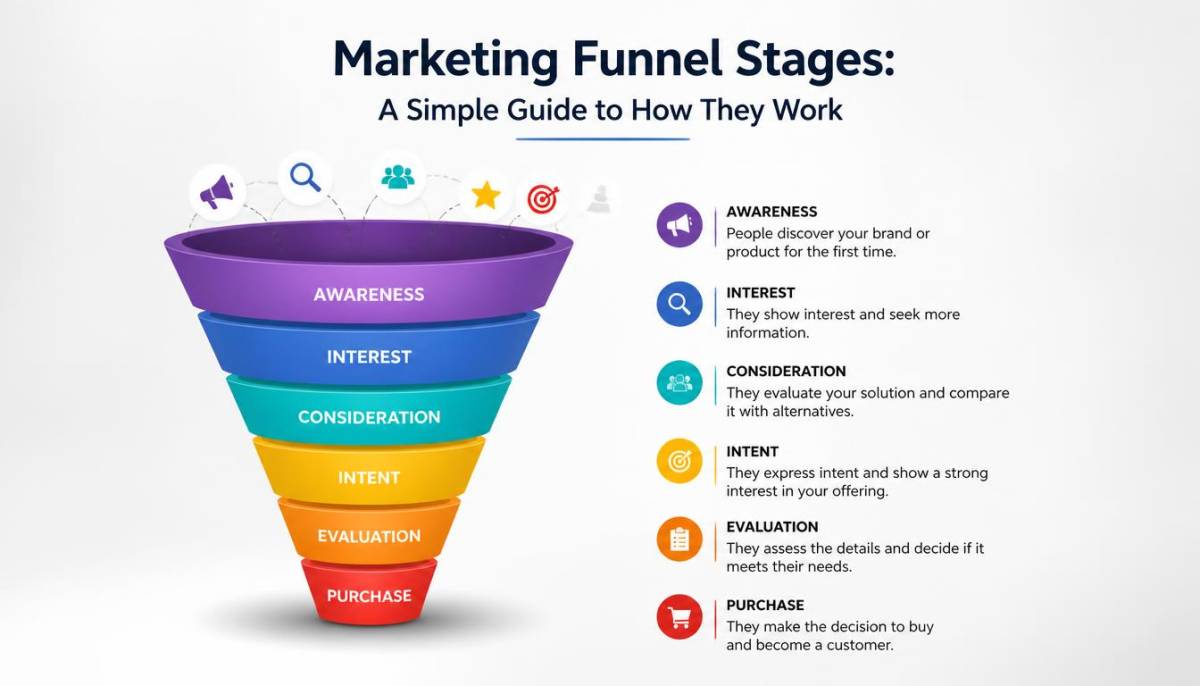
Marketing Funnel Stages: A Simple Guide to How They Work
People rarely see a brand for the first time and immediately buy something.
Usually, the journey starts with a simple introduction. Someone sees a social media post, finds a page through Google, hears about a business from a friend, or comes across an ad. Then they start looking around, comparing options, and deciding whether the brand is worth their money.
That journey is what a marketing funnel helps businesses understand.
The marketing funnel stages describe the different steps a potential customer can move through, from discovering a business to buying from it, staying loyal, and eventually recommending it to others.
The exact funnel can look different from one business to another, but five stages are commonly used: awareness, consideration, conversion, loyalty, and advocacy.
What Are Marketing Funnel Stages?
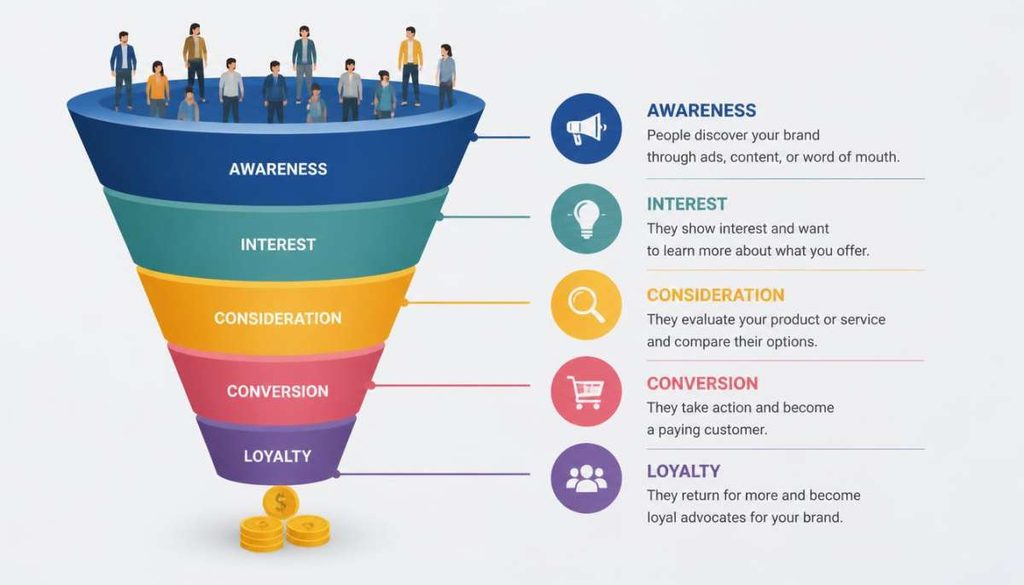
Marketing funnel stages are the different points a person passes through during their journey with a business.
At the beginning, they might not even know your brand exists. Later, they could become interested in what you offer, compare you with other options, make a purchase, and eventually become a repeat customer.
Think of it like meeting someone for the first time.
You wouldn’t expect them to trust you completely after one conversation. The relationship develops over time. Marketing works in a similar way.
A funnel gives marketers a simple framework for understanding where people are in that journey and what kind of message might be useful at each point.
The 5 Stages of the Marketing Funnel
The traditional funnel is often divided into three broad parts: top of the funnel (TOFU), middle of the funnel (MOFU), and bottom of the funnel (BOFU).
A more detailed version breaks the journey into five stages:
- Awareness
- Consideration
- Conversion
- Loyalty
- Advocacy
Here’s what each stage looks like in practice.
1. Awareness
Awareness is where the customer first discovers your business.
They might see your Instagram video, come across a Google search result, watch a YouTube video, notice an advertisement, or hear about your company from someone else.
At this point, they aren’t necessarily looking to buy.
They are simply becoming aware that you exist.
The main goal here is to get the right people familiar with your brand and the problem you solve.
Common awareness tactics include:
- Social media content
- Search engine optimization
- Display advertising
- YouTube videos
- Educational blog posts
- Influencer collaborations
- Podcasts and other media
For example, imagine someone wants to start exercising but doesn’t know which type of running shoes to buy. They search Google for beginner running tips and discover an article from a sports brand.
They haven’t decided to buy anything yet. But now they know the brand exists.
That’s awareness.
2. Consideration
Now the person knows about your brand and starts paying closer attention.
They may visit your website, read reviews, compare products, watch demonstrations, subscribe to your email list, or search for more information.
This is the consideration stage.
The customer is essentially asking:
“Is this actually right for me?”
This is where helpful information can make a big difference.
Businesses often use:
- Product comparisons
- Case studies
- Reviews
- Detailed guides
- Webinars
- Product demonstrations
- Email content
- FAQs
- Customer testimonials
Let’s go back to the running-shoe example.
The person has now found several brands. They start comparing cushioning, durability, price, reviews, and features.
They’re getting closer to a decision, but they’re not ready to click “Buy” yet.
3. Conversion
This is the stage where interest turns into action.
The customer might purchase a product, book a service, request a quote, create an account, or complete another important action.
For an ecommerce business, conversion usually means a purchase.
For a B2B company, it could mean booking a sales call or signing a contract.
At this point, unnecessary friction can cost you the customer.
A complicated checkout, unclear pricing, slow website, confusing product information, or weak call to action can make someone leave even when they’re genuinely interested.
Businesses often focus on:
- Clear calls to action
- Simple checkout processes
- Strong product pages
- Free trials
- Demonstrations
- Special offers
- Trust signals
- Reviews and testimonials
In our example, the shopper has compared several pairs of shoes and finally chooses one.
They place the order.
That’s conversion.
4. Loyalty
The funnel doesn’t have to end after someone buys.
In fact, the relationship after the purchase can be just as valuable.
The loyalty stage focuses on keeping customers satisfied and giving them good reasons to return.
This can involve:
- Helpful customer support
- Product education
- Follow-up emails
- Loyalty programs
- Exclusive offers
- Personalized recommendations
- Easy returns
- Useful post-purchase content
Imagine the customer receives their running shoes and has a smooth experience. The company sends useful information about breaking in the shoes and later recommends suitable running socks.
The customer has a positive experience and decides to buy from the same brand again.
That’s loyalty.
5. Advocacy
Advocacy happens when satisfied customers start talking about your business and recommending it to other people.
This can be one of the most valuable outcomes of a good customer experience because the recommendation comes from someone the new customer already trusts.
Advocacy can take several forms:
- Online reviews
- Referrals
- Social media posts
- Word-of-mouth recommendations
- User-generated content
- Customer testimonials
For example, the runner who loved their shoes might post a review or recommend them to a friend who has just started running.
The customer has moved from simply buying from the brand to actively promoting it.
That’s advocacy.
TOFU, MOFU, and BOFU Explained
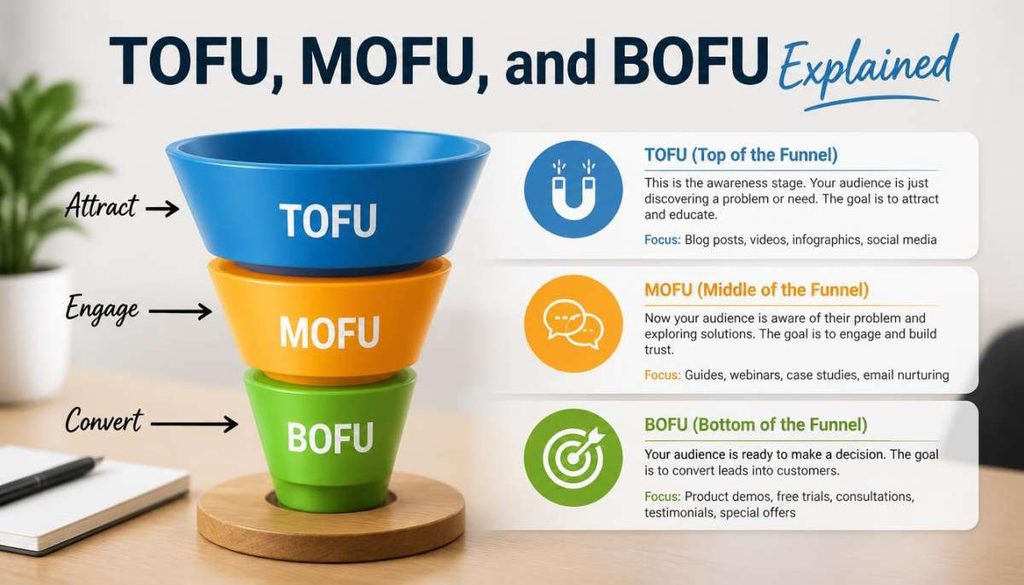
You will often see marketing funnels described using three abbreviations: TOFU, MOFU, and BOFU.
Don’t let the names make them sound more complicated than they are.
TOFU: Top of the Funnel
TOFU represents the awareness part of the customer journey.
The audience is usually broad, and many people may not know much about your brand yet.
Typical content includes:
- Educational articles
- Social media posts
- Videos
- Podcasts
- Search content
- Awareness campaigns
The goal is to attract relevant people rather than immediately push them toward a purchase.
MOFU: Middle of the Funnel
MOFU is mainly associated with consideration.
People already have some awareness of the brand or the problem they’re trying to solve. Now they’re researching their options.
Useful content can include:
- Comparisons
- Case studies
- Product guides
- Webinars
- Reviews
- Email sequences
- Detailed educational content
The goal is to help potential customers make a more informed decision.
BOFU: Bottom of the Funnel
BOFU is closest to the buying decision.
People at this point often need a final reason to choose your business.
Useful tactics include:
- Product demonstrations
- Free trials
- Consultations
- Testimonials
- Pricing information
- Strong product pages
- Clear calls to action
TOFU, MOFU, and BOFU are useful shorthand, while the five-stage model gives you a more detailed view of what happens before and after the purchase.
Marketing Funnel Stages Example
Let’s put everything together with a simple example.
Imagine a company selling premium coffee subscriptions.
Awareness: Someone sees the company’s Instagram video about choosing better coffee beans.
Consideration: They visit the website and read about different coffee varieties and subscription options.
Conversion: They choose a plan and place their first order.
Loyalty: The company sends brewing tips and reminds them when their next shipment is coming.
Advocacy: The customer enjoys the coffee and recommends the subscription to a friend.
Notice that the marketing doesn’t stop at the sale.
Each stage has a different purpose, and the message changes as the customer’s relationship with the business develops.
Marketing Funnel vs. Sales Funnel
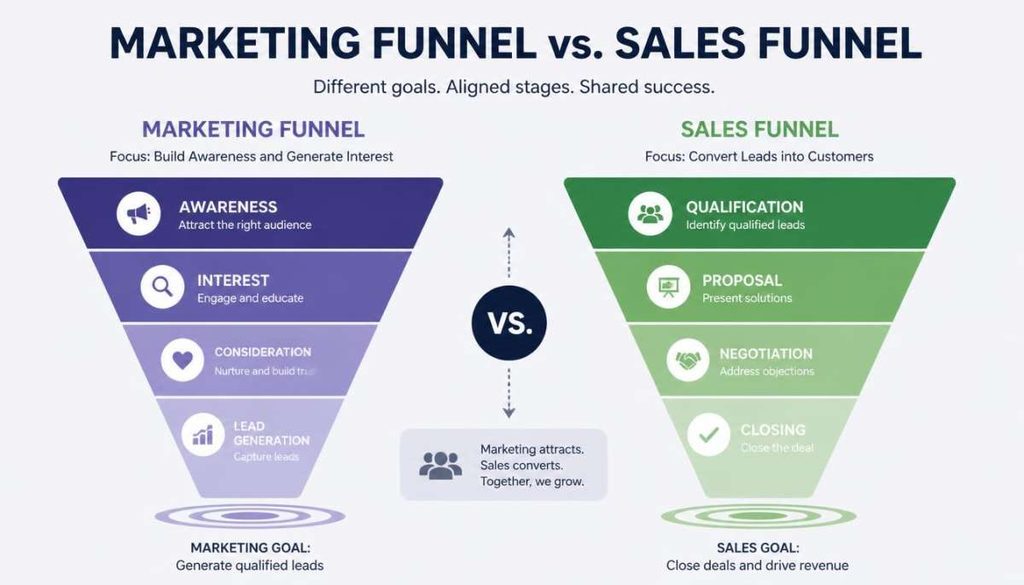
Marketing and sales funnels overlap, but they aren’t exactly the same thing.
A marketing funnel generally focuses on attracting people, creating interest, educating potential customers, and building relationships.
A sales funnel usually focuses more directly on moving qualified prospects toward a purchase.
For example, a marketing team might bring 10,000 relevant visitors to a website through content and advertising.
From there, some visitors become leads. A sales team may then speak with qualified leads, answer questions, provide proposals, and close deals.
The two funnels work together rather than existing as completely separate journeys.
Marketing Funnel Metrics to Track
You don’t need to measure every number imaginable.
The useful metrics depend on the stage you’re looking at.
Awareness metrics
You might track:
- Reach
- Impressions
- Website traffic
- Video views
- Brand searches
- Engagement
These help show whether people are discovering your business.
Consideration metrics
Useful numbers can include:
- Time on site
- Content engagement
- Email signups
- Product page visits
- Leads
- Demo requests
These can give you a better idea of whether people are seriously exploring the offer.
Conversion metrics
Here, the numbers become more directly tied to business results.
Common metrics include:
- Conversion rate
- Cost per acquisition
- Sales
- Revenue
- Average order value
- Lead-to-customer rate
Loyalty metrics
After the purchase, look at things such as:
- Repeat purchase rate
- Customer retention
- Churn
- Customer lifetime value
- Repeat revenue
The goal is to understand whether customers are sticking around.
Advocacy metrics
You can also monitor:
- Referral rate
- Reviews
- Referral revenue
- User-generated content
- Customer recommendations
These numbers can help you see whether satisfied customers are bringing new people into the funnel.
How to Build a Marketing Funnel
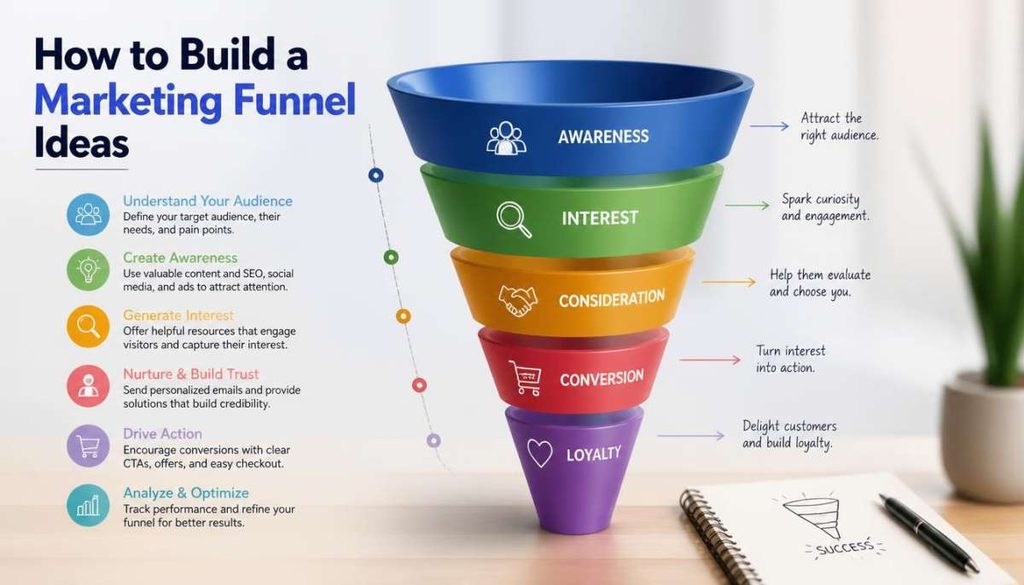
You don’t need a complicated system to create a useful funnel.
Start with the customer journey.
1. Define your audience
First, understand who you’re trying to reach and what problem they want to solve.
2. Create awareness content
Give potential customers a useful reason to discover your brand.
That could be a helpful article, video, social post, podcast, or search result.
3. Help people evaluate their options
Once people know you exist, give them information that helps them make a decision.
Comparisons, demonstrations, reviews, guides, and FAQs can all be useful here.
4. Make the next step obvious
When someone is ready to act, don’t make them hunt for the next step.
Use clear calls to action and remove unnecessary friction.
5. Keep the relationship going
After the sale, continue providing value.
Good onboarding, customer service, helpful emails, and relevant recommendations can encourage customers to return.
6. Give customers a reason to recommend you
If customers have a genuinely positive experience, make it easy for them to leave reviews or refer others.
Common Marketing Funnel Mistakes
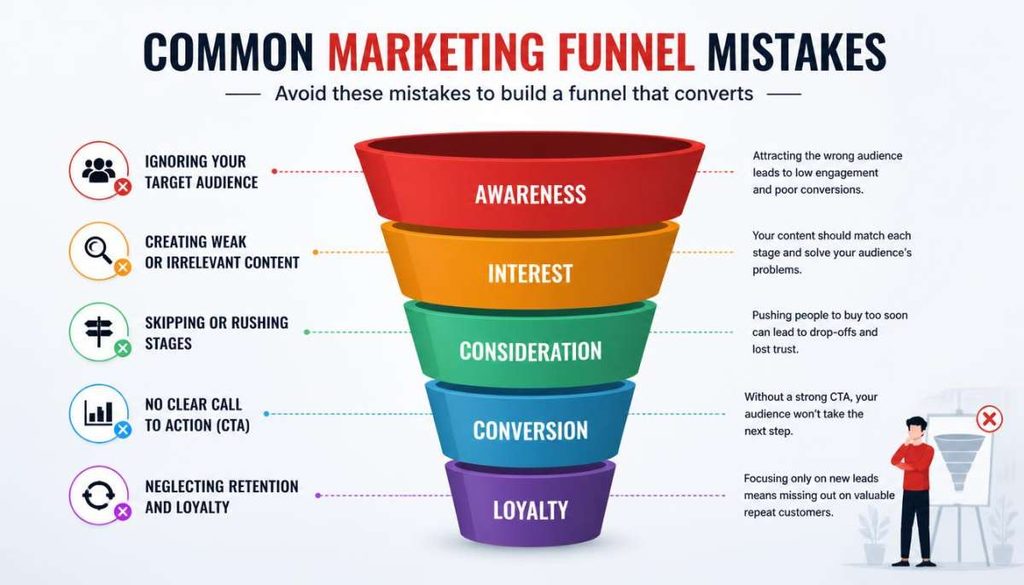
A funnel can look great on paper and still perform poorly in practice.
Here are some mistakes worth watching for.
Treating everyone the same
Someone discovering your brand for the first time doesn’t need the same message as someone who has already visited your pricing page three times.
Match your content to where the person is in their journey.
Focusing only on getting the sale
A purchase is important, but it isn’t always the end of the customer relationship.
Ignoring retention can mean spending more money constantly finding new customers.
Measuring only traffic
Lots of visitors sound impressive, but traffic alone doesn’t tell you whether the funnel is producing customers.
Connect your traffic data with leads, conversions, revenue, and retention.
Making the buying process difficult
If someone is ready to buy but has to click through five confusing pages to finish the order, you have created an unnecessary obstacle.
Keep important actions simple.
Forgetting existing customers
Businesses often spend most of their marketing effort chasing new customers while overlooking people who have already purchased.
Existing customers already know your brand. A good post-purchase experience can turn one transaction into a longer relationship.
Frequently Asked Questions About Marketing Funnel Stages
What are the 5 stages of a marketing funnel?
The five commonly used stages are awareness, consideration, conversion, loyalty, and advocacy. They describe the journey from discovering a brand through purchasing and potentially recommending it to others.
What are TOFU, MOFU, and BOFU?
TOFU means top of the funnel, MOFU means middle of the funnel, and BOFU means bottom of the funnel. They broadly represent awareness, consideration, and conversion.
What is an example of a marketing funnel?
A customer might discover a brand through a social media post, research its products, make a purchase, receive helpful follow-up communication, buy again, and eventually recommend the brand to someone else.
What is the difference between a marketing funnel and a sales funnel?
A marketing funnel generally covers attracting and nurturing potential customers, while a sales funnel focuses more closely on qualifying prospects and moving them toward a purchase. In many businesses, the two work closely together.
Why are marketing funnel stages important?
They give businesses a way to understand where potential customers are in their journey. That makes it easier to create relevant content, choose appropriate marketing tactics, and measure what happens before and after a purchase.
What metrics should you track at each funnel stage?
The right metrics depend on the stage. Awareness might involve reach and traffic, consideration can include leads and engagement, conversion can focus on sales and conversion rate, while loyalty and advocacy can involve retention, repeat purchases, lifetime value, and referrals.
Is every customer supposed to move through every funnel stage?
No. Real customer journeys aren’t perfectly linear. Someone might discover a brand, leave, return weeks later, compare several products, purchase immediately, or skip certain steps altogether. The funnel is a framework for understanding behavior, not a strict path every customer must follow.