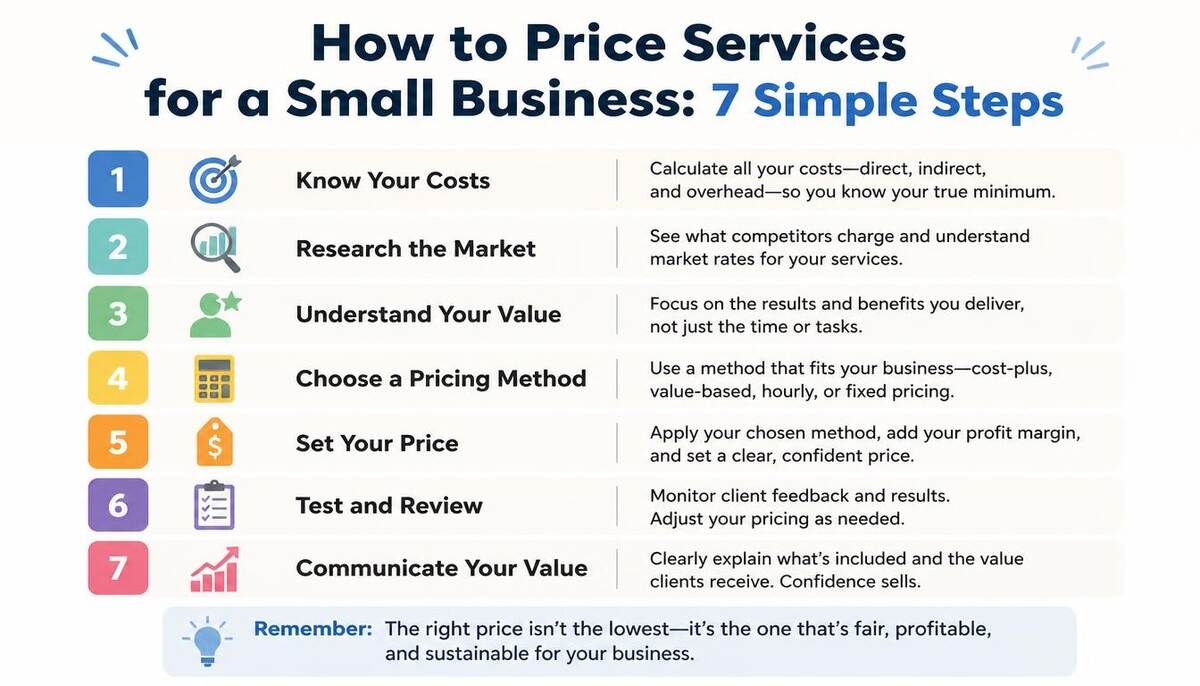
How to Price Services for a Small Business: 7 Simple Steps
Use up and down arrow keys to resize the meta box pane.
Setting the right price for your services can make a major difference in how profitable your small business becomes. Charge too little, and you may struggle to cover expenses. Charge too much without showing customers the value, and potential clients may choose another provider.
The challenge is finding a price that covers your business costs, pays you fairly for your time, and leaves enough profit to support future growth.
If you are wondering how to price services for a small business, you do not need to rely on guesswork. A practical pricing strategy starts with your expenses, considers your customers and competitors, and gives you room to adjust as your business grows.
This guide explains seven steps to help you calculate service prices, choose a pricing model, and avoid common mistakes.
Why Pricing Your Services Correctly Matters
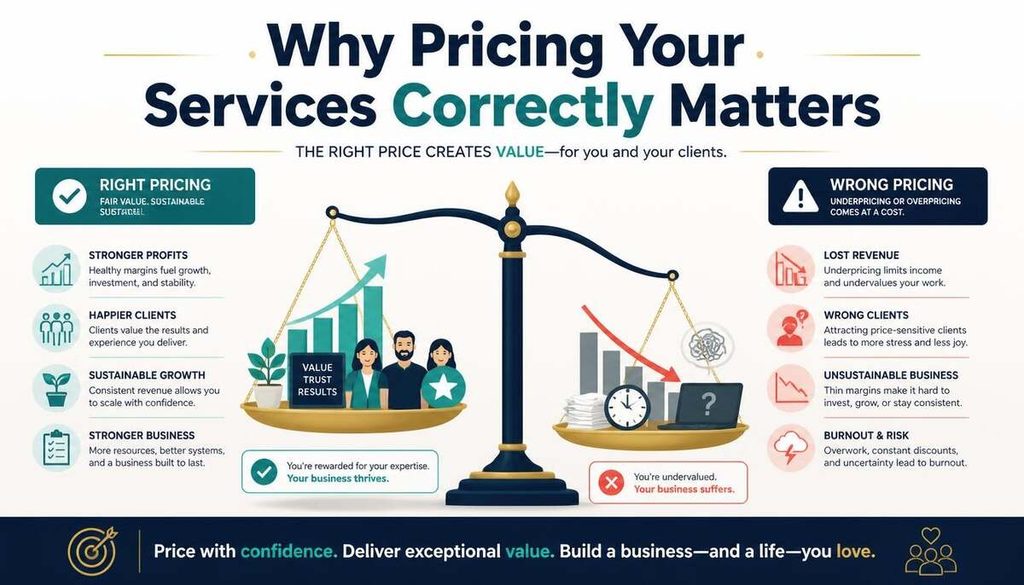
Pricing affects more than the amount of money you receive from each customer. It influences your profitability, workload, business reputation, and ability to grow.
When your prices are too low, you may attract plenty of customers but still struggle financially. You might spend hours completing projects without earning enough to cover your operating expenses.
On the other hand, a reasonable price helps you:
- Cover business expenses and labor costs
- Earn a sustainable profit
- Pay yourself fairly
- Invest in equipment, marketing, and training
- Build a business that can handle slower periods
- Attract customers who appreciate your service quality
Pricing also affects how customers perceive your business. A very low price may sometimes create doubts about quality, while a higher price needs to be supported by clear value.
The goal is not simply to charge more. It is to charge an amount that makes sense for your business and your customers.
7 Steps to Price Services for a Small Business
A reliable pricing process helps you make decisions based on actual business numbers instead of emotions or competitor prices.
1. Calculate Your Total Business Costs
Before deciding what to charge, understand how much it costs to operate your business.
Many small business owners calculate the materials or supplies used for a project but forget the expenses that keep the business running.
Common business costs include:
- Rent and utilities
- Internet and phone bills
- Software subscriptions
- Marketing and advertising
- Insurance
- Equipment and maintenance
- Business licenses
- Payment processing fees
- Office supplies
- Transportation
- Accounting and administrative expenses
Separate your expenses into fixed and variable costs.
Fixed costs remain relatively consistent each month. Rent, insurance, and software subscriptions are common examples.
Variable costs change depending on the amount of work you complete. Materials, project supplies, travel expenses, and transaction fees may fall into this category.
For example, a cleaning business may pay $800 monthly for insurance, software, storage, and other overhead. It may also spend $25 on supplies for each cleaning appointment.
Both types of expenses need to be included when calculating service prices.
2. Calculate Your Labor Cost
Your time is one of the most important costs in a service business.
If you charge customers only for the hours spent completing the main service, you may forget the time required for other business activities.
Consider the time spent on:
- Customer communication
- Preparing quotes
- Planning projects
- Purchasing supplies
- Traveling to customers
- Invoicing
- Revising completed work
- Managing business operations
Suppose you want to earn $40 per working hour. You work 40 hours each week, but only 25 hours are billable because the remaining time goes toward administration, marketing, and other tasks.
Your business cannot simply charge $40 for each billable hour and expect that to cover everything.
You need to account for the fact that only part of your working time generates direct customer revenue.
One practical approach is to calculate your desired annual income and business expenses, then divide that amount by your realistic annual billable hours.
This gives you a better starting point for your hourly rate.
3. Decide Your Desired Profit Margin
After calculating your expenses and labor, determine how much profit you want your business to earn.
Profit is the money remaining after the relevant business costs have been deducted from revenue.
Do not confuse profit margin with markup. They are related, but they are calculated differently.
Profit margin measures profit as a percentage of the selling price.
Markup measures the amount added to cost as a percentage of the cost.
For example, if a service costs $100 to deliver and you sell it for $150:
- Profit: $50
- Profit margin: 33.33%
- Markup: 50%
This difference matters because adding a 30% markup does not produce a 30% profit margin.
Your desired margin will depend on your industry, operating expenses, business goals, and customer demand. Avoid choosing a percentage simply because another business uses it.
4. Research Competitor Pricing
Competitor research helps you understand the prices customers may encounter when comparing service providers.
Look at businesses offering similar services to the same type of customer.
Consider:
- Their service packages
- What each package includes
- Their experience and reputation
- Their target customers
- Their service quality
- Whether they charge hourly or per project
Try to compare businesses with similar offerings.
For example, a freelance designer who provides strategy, custom illustrations, and multiple revisions should not automatically charge the same amount as someone offering a basic template.
Competitor pricing is useful for understanding the market, but it should not determine your price entirely.
Your expenses, experience, service quality, and customer value still matter.
5. Understand Your Customer’s Value
Customers do not always choose a service based on price alone.
They may pay more for convenience, expertise, reliability, faster delivery, or a result that saves them time and money.
This is where value based pricing can become useful.
Instead of calculating your price only from the time required, consider the value your service creates for the customer.
For example, a consultant might help a business reduce unnecessary expenses by $20,000 annually. A consulting service that creates measurable financial value may justify a higher fee than one based only on the number of hours spent.
To understand customer value, ask yourself:
- What problem does my service solve?
- How much time does it save?
- What financial benefit could it provide?
- What makes my service different?
- Why would customers choose me over another provider?
Your price should reflect the value you can realistically deliver, not simply the value you hope customers will perceive.
6. Choose the Right Pricing Model
Different service businesses benefit from different pricing structures. The best model depends on how predictable your work is and what customers expect.
Hourly Pricing
You charge customers for each hour of work.
Hourly pricing can work well for consultants, freelancers, tutors, and services where the amount of work is difficult to predict.
The main disadvantage is that customers may focus on the number of hours rather than the final result.
Flat Rate Pricing
You charge one fixed amount for a clearly defined service.
This model works well for services with predictable requirements, such as basic cleaning packages, standard repairs, or specific design tasks.
Make sure the service scope is clearly defined so additional work does not reduce your profit.
Project Based Pricing
You charge a single fee for completing a project.
This approach is common for web development, marketing campaigns, consulting projects, and design work.
Project pricing can reward efficiency, but you need to estimate the workload carefully.
Retainer Pricing
Customers pay a recurring amount for ongoing access to your services.
Retainers are useful for businesses offering monthly marketing, consulting, maintenance, or support.
They can provide more predictable revenue, but the agreement should clearly explain what is included.
Value Based Pricing
You set your price based on the value your service provides to the customer.
This model can work well for specialized consulting, business strategy, and services that produce measurable results.
It requires a strong understanding of customer needs and the outcomes your service can deliver.
7. Test and Adjust Your Prices
Your first pricing strategy does not have to remain unchanged forever.
As your business grows, your costs, experience, demand, and service quality may change.
Review your prices regularly and monitor:
- Revenue per customer
- Profit per service
- Customer conversion rate
- Time spent completing projects
- Customer satisfaction
- Repeat business
- Operating expenses
If you are consistently busy but earning very little profit, your prices may be too low or your service delivery costs may be too high.
If customers frequently reject your quotes, review your pricing, customer targeting, and how clearly you communicate the value of your service.
Avoid making price changes based on one customer interaction. Look for patterns before adjusting your strategy.
How to Calculate Your Service Price
A pricing formula gives you a starting point for deciding what to charge.
However, remember that a formula cannot replace your understanding of customer demand, market conditions, and service value.
Service Pricing Formula
A simple starting formula is:
Service Price = Total Service Cost + Desired Profit
For a more specific calculation based on a target profit margin, use:
Price = Total Cost ÷ (1 − Desired Profit Margin)
Use the profit margin as a decimal in the calculation.
For example, a 30% margin becomes 0.30.
Service Pricing Calculation Example
Suppose you operate a small service business and the total cost of completing one service is $100.
You want to earn a 30% profit margin.
The calculation would be:
Price = $100 ÷ (1 − 0.30)
Price = $100 ÷ 0.70
Price = $142.86
You would need to charge approximately $142.86 to achieve a 30% margin before considering any additional costs not included in the original $100 estimate.
If you charged $130 instead, your profit would be $30.
Your profit margin would be:
$30 ÷ $130 × 100 = 23.08%
This demonstrates why simply adding 30% to your costs does not create a 30% profit margin.
Profit Margin vs. Markup
Here is a quick comparison:
| Total Cost | Selling Price | Profit | Profit Margin | Markup |
| $100 | $120 | $20 | 16.67% | 20% |
| $100 | $130 | $30 | 23.08% | 30% |
| $100 | $150 | $50 | 33.33% | 50% |
If you need help evaluating related business numbers, you can also explore the Bussinology calculator resources.
Service Pricing Examples for Different Small Businesses
The best pricing approach depends on the type of service you provide.
Freelance Services
Freelancers often use hourly, project based, or retainer pricing.
A freelance writer might charge per article, while a graphic designer may charge a fixed fee for a logo package.
When calculating prices, include time spent researching, communicating with clients, making revisions, and managing projects.
Do not base your rate only on the time spent producing the final deliverable.
Consulting Services
Consultants may charge hourly rates, daily rates, project fees, or retainers.
Specialized consultants often consider the business impact of their recommendations when setting prices.
For example, a consultant helping a company improve its operations may price a project according to its complexity, expertise required, and expected value.
The scope of work should be clear before the project begins.
Cleaning Services
Cleaning businesses may charge by the hour, room, property size, or type of cleaning.
A standard cleaning service may have a fixed price, while deep cleaning or unusual properties may require a customized quote.
Consider labor, supplies, transportation, property size, and the condition of the space.
Marketing Agencies
Marketing agencies commonly use retainers, project fees, or service packages.
A monthly package might include content creation, social media management, reporting, and strategy.
The agency should calculate the staff time, software costs, advertising management workload, and client communication required to deliver the package.
Personal and Professional Services
Personal trainers, tutors, photographers, repair professionals, and other service providers may use hourly or package pricing.
Packages can make it easier for customers to understand what they are buying.
For example, a photographer might offer different packages based on session length, editing, and the number of final images.
Clearly explain what is included in each package to avoid misunderstandings.
Common Service Pricing Mistakes to Avoid
Even experienced business owners can make pricing mistakes.
Here are some common issues to watch for.
Charging too little: Low prices may attract customers, but they can make it difficult to cover expenses and pay yourself fairly.
Ignoring overhead: Remember that rent, software, insurance, marketing, and administrative expenses contribute to the cost of operating your business.
Copying competitors: Competitors may have different costs, experience, customers, or service quality.
Confusing markup with margin: Adding a percentage to your costs does not produce the same percentage as your profit margin.
Offering unlimited work: Unlimited revisions, support, or project changes can increase your workload without increasing revenue.
Keeping outdated prices: Your expenses and business value may change over time.
Failing to define the scope: Customers should understand what is included and what requires an additional charge.
One useful habit is to review your small business cash flow management strategy alongside your pricing. Healthy revenue does not always mean your business has enough cash available to cover its obligations.
How to Increase Service Prices Without Losing Customers
Raising prices can feel uncomfortable, especially when you have long term customers.
However, price increases may become necessary when your expenses rise, your expertise improves, or your service becomes more valuable.
Here are some ways to make the process smoother.
Give customers advance notice. Avoid surprising existing clients with an immediate price change whenever possible.
Explain the reason clearly. You can mention increased operating costs, improved services, or changes in your business offering.
Show the value of your service. Explain what customers receive and why your service continues to be worthwhile.
Offer different packages. Customers with smaller budgets may prefer a basic package, while others may want additional services.
Apply changes consistently. Make sure your pricing policy is clear and fair.
You do not need to apologize for charging a reasonable amount for valuable work. Communicate professionally and give customers enough information to make their own decisions.
When Should a Small Business Review Its Pricing?
Pricing should be reviewed whenever important business conditions change.
Consider reviewing your prices when:
- Your operating expenses increase
- You hire employees or contractors
- Customer demand grows significantly
- You invest in better equipment or training
- Your service becomes more specialized
- Your profit margins begin to decline
- You introduce new service packages
- You discover that projects regularly take longer than expected
You may also want to review pricing at regular intervals, such as every six or twelve months.
The purpose is not to increase prices automatically. It is to make sure your current rates still support your business goals.
FAQs About Pricing Services for a Small Business
How Much Profit Should a Small Service Business Make?
There is no single profit margin that works for every service business. Your ideal margin depends on your industry, expenses, workload, and business goals. Focus on maintaining enough profit to cover risks, reinvest in your business, and support long term operations.
How Do I Calculate an Hourly Rate for My Business?
Start with your desired annual income and add the business expenses that need to be covered through your work. Divide that amount by your realistic annual billable hours. This gives you a starting hourly rate before considering market positioning and customer value.
Should I Charge Hourly or Use Flat Rate Pricing?
Hourly pricing works well when the amount of work is unpredictable. Flat rate pricing can be more attractive when the service has a clear scope and predictable delivery requirements. Choose the model that fits your business and customer expectations.
How Do I Price Services When Starting a Business?
Calculate your expenses, labor requirements, and desired profit. Research competitors and understand what customers value. Start with a price that supports your business rather than relying on extremely low introductory rates.
Is It Better to Charge Less Than Competitors?
Not necessarily. Lower prices may attract price sensitive customers, but they can reduce your profitability. Compete through service quality, reliability, expertise, convenience, and value rather than relying entirely on discounts.
What Is the Difference Between Markup and Profit Margin?
Markup is calculated using your cost as the base. Profit margin is calculated using your selling price as the base. A 30% markup does not equal a 30% profit margin.
How Often Should a Small Business Increase Prices?
Review prices at least periodically and whenever your expenses, workload, service value, or market conditions change. You do not need to increase prices on a fixed schedule if your current pricing remains profitable and competitive.
How Do I Know If I Am Charging Too Little?
You may be undercharging if you consistently work long hours, struggle to cover expenses, earn little profit, or cannot afford to invest in your business. Compare your actual costs and workload with the revenue your services generate.
Build a Pricing Strategy That Supports Your Business
Learning how to price services for a small business is an ongoing process. The right price should cover your expenses, pay you fairly for your work, and provide enough profit to keep your business moving forward.
Start by calculating your costs and labor. Then consider your desired profit margin, competitor pricing, customer value, and the pricing model that fits your service.
Review your numbers regularly and make adjustments when your business changes.
A thoughtful pricing strategy helps you move beyond simply staying busy. It gives you a better chance of building a profitable business that can grow sustainably.