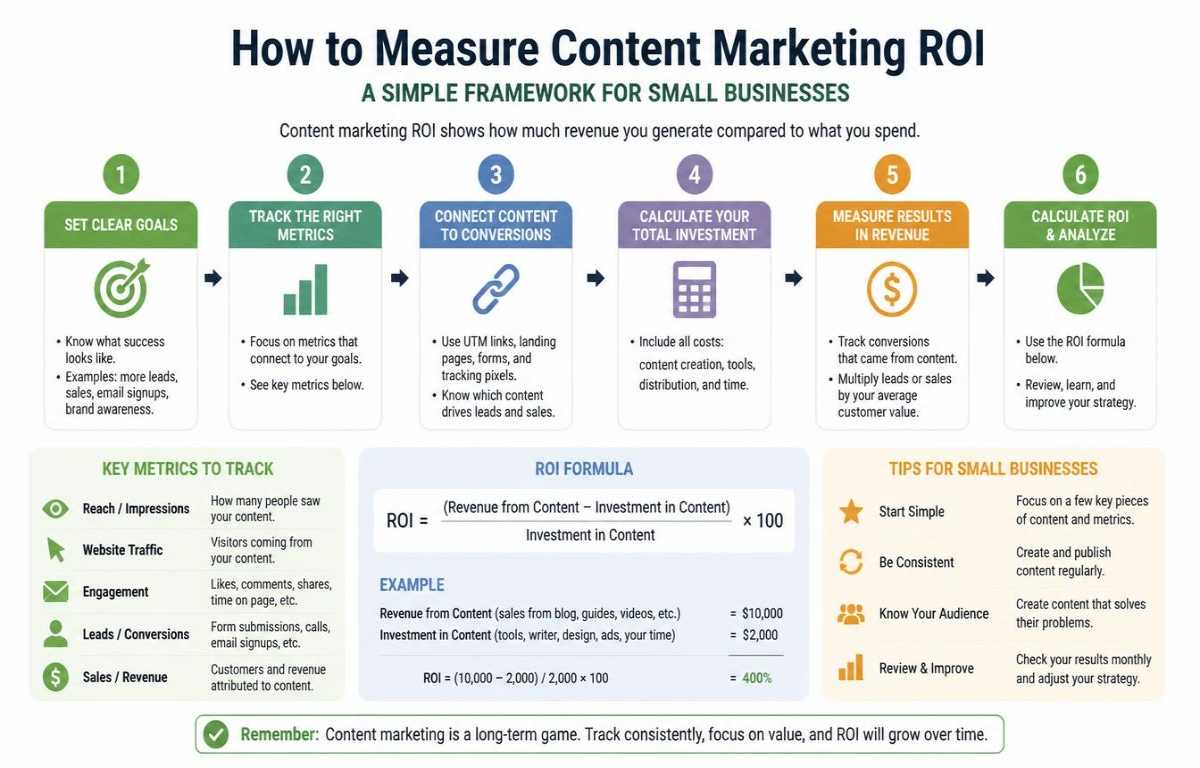
How to Measure Content Marketing ROI for a Small Business
Publishing blog posts, creating social media content, and sending marketing emails all take time and money. For a small business, every hour and dollar matters. You need to know whether those efforts are attracting potential customers, generating sales, or simply bringing visitors who leave without taking action.
Learning how to measure content marketing ROI for a small business helps you understand which activities contribute to your business goals. Instead of judging success by page views or social media likes alone, you can evaluate the leads, sales, and profit your content helps generate.
The good news is that you do not need an expensive analytics platform to get started. With clear goals, accurate cost tracking, and a simple measurement process, you can make better decisions about where to invest your marketing budget.
What Is Content Marketing ROI?
Content marketing return on investment, commonly called ROI, measures the financial return generated by your content compared with what you spent creating and promoting it.
Your content might include blog articles, videos, email newsletters, downloadable guides, case studies, or social media posts. Each format can support a different business goal.
For example, a blog post might bring visitors to your website, encourage some of them to subscribe to your email list, and eventually help a few become paying customers. A video might introduce your brand to new people who later visit your website and make a purchase.
Content marketing ROI helps you understand whether the financial results justify the investment.
However, not every useful result creates immediate revenue. Some content builds awareness, answers customer questions, supports existing customers, or helps potential buyers compare their options. These contributions matter, but they should be measured according to their actual purpose rather than treated as direct sales.
The Content Marketing ROI Formula
A commonly used revenue based ROI formula is:
Content marketing ROI = ((Revenue attributed to content − Content marketing cost) ÷ Content marketing cost) × 100
This formula compares the revenue associated with your content against the cost of producing and distributing it.
For example, suppose your business spends $800 on content marketing and attributes $2,000 in revenue to that activity.
Your calculation would be:
ROI = (($2,000 − $800) ÷ $800) × 100
ROI = 150%
This means the attributed revenue exceeded the marketing cost by an amount equal to 150% of that cost.
There is one important distinction. Revenue based ROI does not account for the cost of delivering the products or services sold. For a more accurate profitability assessment, use the profit generated by those sales instead of revenue.
How to Calculate Content Marketing Costs
Start by recording every expense associated with the content you want to evaluate.
Your costs may include:
- Freelance writers, editors, designers, and video creators
- Employee time spent planning, producing, and reviewing content
- Content management and marketing software
- Image, video, and design subscriptions
- Paid promotion and content distribution
- Website hosting or other relevant publishing expenses
You do not necessarily need to include every general business expense. Focus on costs that are reasonably attributable to the content marketing activity you are measuring.
For example, if a freelancer charges $180 for a blog post, an editor costs $40, and you spend $30 promoting it, the direct cost is $250.
For a campaign containing several articles and videos, add the relevant production, labor, software, and distribution costs for the period being measured.
Be consistent with your method. If you include employee time for one campaign, include comparable labor costs when evaluating another campaign.
How to Calculate Revenue Attributed to Content
The next step is connecting content activity to business results.
Depending on your business model, relevant results may include:
- Online purchases
- Qualified sales leads
- Booked consultations
- Service inquiries
- Paid subscriptions
- Product demonstrations that lead to sales
Use analytics, website forms, customer relationship management records, and campaign tracking links to understand how customers discovered your business and what happened afterward.
For example, a customer might first find your website through a search engine, read two blog articles, subscribe to your newsletter, and purchase a service three weeks later.
That journey is more complex than a single click. Your tracking approach should acknowledge the different interactions without counting the same sale multiple times.
When you cannot confidently connect a sale to a particular article or campaign, label the result as influenced or unattributed rather than presenting it as proven direct revenue.
Revenue Based ROI vs Profit Based ROI
Revenue is not the same as profit.
Imagine a business generates $3,000 in sales from a content campaign but spends $1,500 on producing and promoting its content. The revenue based formula shows a 100% ROI.
However, the business also has product costs, delivery expenses, payment fees, and other costs associated with those sales.
For a profit based calculation, estimate the profit attributable to the content before deducting the marketing investment.
Profit based ROI = ((Profit attributable to content − Content marketing cost) ÷ Content marketing cost) × 100
If the sales generate $1,200 in gross profit and the content campaign costs $600, the profit based ROI is 100%.
This gives you a clearer picture of the campaign’s financial contribution. Use a consistent definition of profit when comparing campaigns.
Which Content Marketing Metrics Should Small Businesses Track?
ROI is an important outcome, but several supporting metrics help explain why a campaign performs well or poorly.
Choose metrics that match your goal instead of trying to monitor every available number.
Organic Traffic and Search Visibility
Organic traffic measures visits that arrive through unpaid search engine results. Search impressions, clicks, and keyword visibility can help you understand whether your articles are reaching potential customers.
These metrics are useful when your goal is to attract people who are actively looking for information related to your products or services.
However, traffic alone does not demonstrate profitability. An article that attracts thousands of unrelated visitors might generate fewer customers than a focused page with a much smaller audience.
Review the search terms attracting visitors, the pages they visit, and whether they take meaningful actions afterward.
Leads, Signups, and Conversion Rates
If your content aims to generate leads, measure how many visitors complete the intended action.
A conversion might be an email signup, consultation request, quote request, or completed contact form.
Conversion rate = (Number of conversions ÷ Number of relevant visitors) × 100
For example, if 500 relevant visitors arrive on a landing page and 25 submit an inquiry, the conversion rate is 5%.
Compare similar pages and campaigns over consistent periods. A high conversion rate is useful, but the quality of the resulting leads matters too. Ten qualified inquiries may be more valuable than 50 inquiries from people who are unlikely to buy.
Sales, Revenue, and Customer Acquisition Cost
Track how many customers purchase after interacting with your content and how much revenue those customers generate.
Customer acquisition cost, or CAC, helps you estimate the cost of gaining a new customer.
Customer acquisition cost = Total acquisition cost ÷ Number of new customers acquired
If you spend $1,200 on a campaign and acquire 12 new customers, the acquisition cost is $100 per customer, assuming the entire campaign cost is included and those customers can reasonably be attributed to it.
For a more useful comparison, evaluate CAC alongside customer profitability and the value customers generate over time.
Email Engagement and Returning Visitors
Email signups, click rates, returning visitors, and repeat purchases can help you understand whether content is building an ongoing relationship with your audience.
These metrics are especially useful for businesses with longer buying journeys or repeat customers.
Still, engagement is not the final financial outcome. A newsletter with a strong click rate may not generate many sales. Use engagement data to identify what interests your audience, then check whether that interest leads to qualified leads, purchases, or retention.
How to Track Content Marketing Results Step by Step
You can establish a practical measurement system without building a complicated reporting process.
Step 1: Set a Clear Business Goal
Decide what you want a piece of content or campaign to achieve.
For example, a local service business might want to generate consultation requests. An online store might want to increase purchases from organic search. A software company might aim to encourage qualified prospects to book a product demonstration.
Choose one primary goal for each campaign. Add supporting metrics only when they help explain the result.
Your goal should be measurable and linked to a defined period.
Step 2: Track Content Costs
Create a spreadsheet that records the cost of each article, video, newsletter, or campaign.
Include production fees, relevant employee time, software costs, and promotion expenses. Record the publication date and the period you plan to evaluate.
This makes it easier to compare the return from different content formats.
If you publish several articles as part of one campaign, you can track both individual article costs and the combined campaign cost.
Step 3: Set Up Conversion Tracking
Use a web analytics tool to monitor important actions, such as purchases, completed forms, and signups.
For search performance, a search performance tool can show which pages attract organic clicks and impressions. Website analytics can help you understand what visitors do after arriving.
Make sure conversion events are configured correctly before relying on the numbers. Test forms and purchase events, check for duplicate tracking, and ensure the reporting period matches your cost records.
Step 4: Use UTM Campaign Links
UTM parameters are tags added to a URL that help analytics tools identify the source and campaign associated with a visit.
They can be useful when sharing content through email newsletters, social media campaigns, and paid promotions.
For example, you could use consistent campaign tags to distinguish newsletter traffic from a paid social campaign. Keep naming conventions simple so that the same campaign does not appear under several different names.
UTM tracking can identify campaign visits, but it does not automatically prove that the campaign caused a later purchase. Combine it with conversion and sales data.
Step 5: Connect Leads to Sales
For many small businesses, a content conversion is only the beginning of the customer journey.
A visitor might download a guide, speak with your sales team, receive a proposal, and purchase weeks later. If you measure only the initial download, you will miss the eventual business outcome.
Record lead sources, qualification status, sales outcomes, and relevant campaign interactions in your customer relationship management system or a well maintained spreadsheet.
When a sale follows several marketing interactions, document your attribution approach. You might use a first touch view to understand discovery, a last touch view to understand the final interaction, or a multi touch approach to consider several interactions.
No single attribution method captures every influence perfectly. The important thing is to use a consistent method and explain its limitations.
How to Measure ROI When a Blog Post Does Not Generate Immediate Sales
Some content creates value over time rather than producing a purchase immediately.
An educational article might attract a visitor who returns later through a branded search. A comparison guide might help someone evaluate different solutions before contacting your sales team. A useful newsletter might keep your business in the customer’s consideration set.
In these cases, look beyond immediate sales while keeping financial claims realistic.
Track relevant intermediate outcomes, such as qualified leads, email subscriptions, assisted conversions, and return visits. Then review whether those outcomes eventually contribute to revenue.
For example, if an article consistently generates qualified leads but the sales process takes several months, evaluating its performance after only one week may be misleading.
Use a measurement window that reflects your typical sales cycle. Compare content performance across similar periods and avoid attributing every later purchase to a previous article simply because the customer viewed it.
You can also use marketing metrics that reveal what is not working to investigate weak results and identify where your tracking or conversion process needs improvement.
Content Marketing ROI Example for a Small Business
Consider a hypothetical small business that publishes educational articles to generate service inquiries.
During a three month period, the business records these results:
| Item | Amount |
|---|---|
| Writing and editing | $900 |
| Relevant software and tools | $150 |
| Content promotion | $150 |
| Total content cost | $1,200 |
| Attributed sales revenue | $4,000 |
| Gross profit attributable to those sales | $2,000 |
Using the revenue based formula:
Revenue based ROI = (($4,000 − $1,200) ÷ $1,200) × 100
Revenue based ROI = 233.3%
Using the profit based formula:
Profit based ROI = (($2,000 − $1,200) ÷ $1,200) × 100
Profit based ROI = 66.7%
Both calculations are useful, but they answer different questions. The first compares attributed revenue with content costs. The second compares the gross profit generated by the sales with those costs.
The profit based calculation is generally more useful for assessing whether the campaign made a positive financial contribution, provided the gross profit figure includes the relevant costs of delivering those sales.
The numbers above are illustrative, not a typical or guaranteed result. Your own outcome will depend on pricing, margins, campaign costs, customer behavior, and the reliability of your attribution data.
How Long Does It Take to See Content Marketing ROI?
There is no single timeline that applies to every business.
A promotional email sent to an engaged customer list may produce purchases quickly. A new educational blog post may need time to gain search visibility, attract relevant visitors, and convert them into leads.
The timeline also depends on competition, publishing frequency, content quality, the strength of your website, and how long customers take to make a buying decision.
For this reason, separate early performance indicators from final financial outcomes.
During the early stages, review whether content is being discovered, attracting relevant visitors, and generating the intended actions. As more data becomes available, evaluate leads, sales, costs, and profitability.
Choose review dates in advance. Avoid changing your measurement period simply because a campaign has not yet produced the result you expected.
If content is not performing, investigate the cause. The problem could be weak search visibility, an irrelevant audience, an unclear call to action, poor lead quality, or a sales process that fails to convert inquiries.
Common Content Marketing ROI Measurement Mistakes
Several common mistakes can make content appear more or less successful than it really is.
Focusing Only on Traffic
More visitors do not automatically mean more customers. Review traffic quality, conversions, and business outcomes together.
Forgetting Hidden Costs
If you record freelancer fees but ignore employee time, software, and promotion, your ROI calculation may overstate the return.
Counting the Same Sale More Than Once
A customer might visit through several channels before buying. Make sure your reporting does not count the same order as a new sale for every interaction.
Treating Every Lead as a Customer
A form submission has potential value, but it is not equivalent to a completed sale. Track lead quality and the percentage of leads that become paying customers.
Ignoring the Sales Cycle
Some content supports decisions that take weeks or months. Evaluate it over a suitable period rather than judging every campaign by immediate sales.
Comparing Different Campaigns Unfairly
A brand awareness video and a sales focused landing page have different purposes. Compare campaigns using goals and metrics appropriate to their intended outcomes.
To improve your measurement process, connect each campaign to a clear business objective. Guides on how marketing funnel stages influence conversions can also help explain why people may interact with content at different points before becoming customers.
Frequently Asked Questions
What Is a Good Content Marketing ROI?
A good ROI depends on your profit margins, customer acquisition costs, sales cycle, and business goals. A positive return can be encouraging, but it should not be judged in isolation. Consider profitability, cash flow, and whether the campaign produces customers who are valuable over time.
Can You Measure Content Marketing ROI Without Paid Tools?
Yes. A spreadsheet, website analytics, search performance reports, and reliable sales records can provide a useful starting point. Paid tools may make reporting easier, but they cannot compensate for missing cost data or poorly configured conversion tracking.
How Often Should a Small Business Calculate Content Marketing ROI?
Review important metrics regularly, such as weekly or monthly, and calculate financial ROI at intervals suited to your campaign and sales cycle. Short campaigns may need faster reviews, while search focused content may require a longer evaluation period.
Is Content Marketing ROI the Same as Conversion Rate?
No. Conversion rate measures the percentage of relevant visitors who complete a desired action. ROI measures the financial return relative to the investment. Conversion rate helps explain performance, while ROI helps assess financial efficiency.
Make Content Marketing Decisions With Better Data
Measuring content marketing ROI becomes easier when you consistently track costs, conversions, sales, and profitability. You do not need to monitor every available metric or invest in complex software before getting started.
Choose a clear goal, record your expenses, connect content interactions to business outcomes, and review the results over an appropriate period. When a campaign falls short, use the data to identify what needs improvement rather than assuming that all content marketing has failed.
For stronger results, set goals that connect your marketing work to real business outcomes. This is especially useful when setting marketing goals that connect to revenue and deciding which content activities deserve more investment.
Over time, this process will help your small business make more informed marketing decisions, prioritize useful content, and understand which efforts contribute most to sustainable growth.