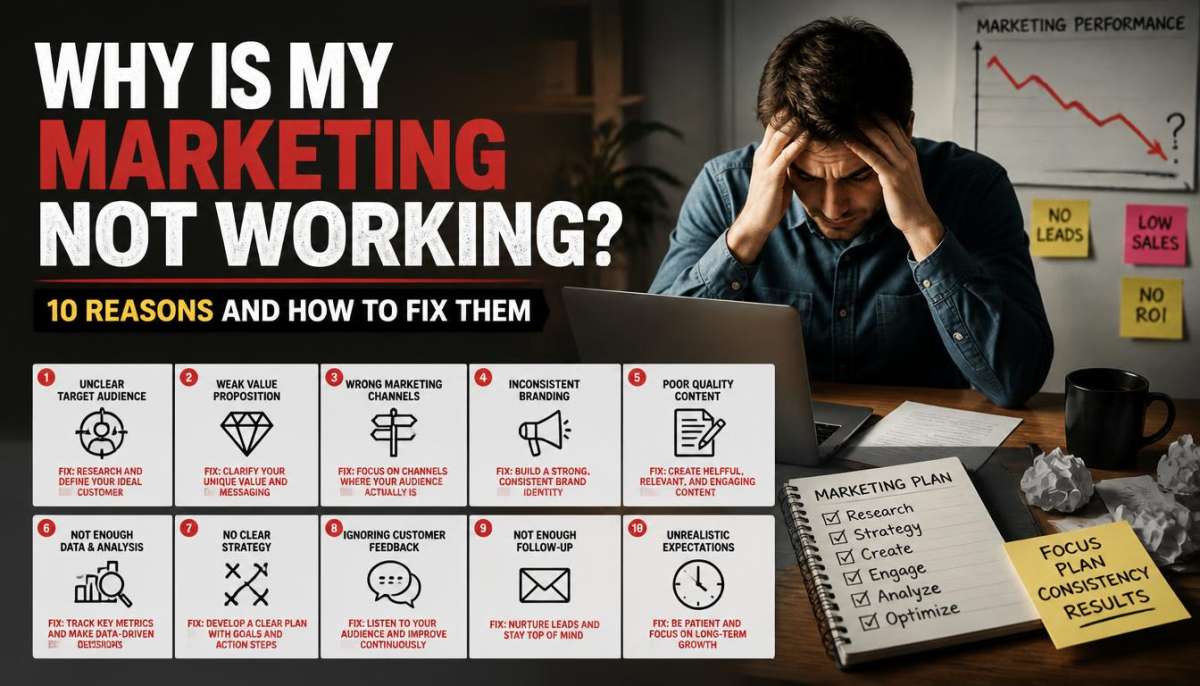
Why Is My Marketing Not Working? 10 Reasons and How to Fix Them
You are posting on social media, running ads, publishing content, or investing in your website, but the results are not what you expected. Maybe your posts get very little engagement, your website receives visitors without generating sales, or potential customers contact you and then disappear. After putting in so much effort, it is natural to wonder, why is my marketing not working?
The problem is not always your budget or the amount of content you publish. Sometimes, your message does not reach the right people. In other cases, customers see your offer but do not understand its value, or your website makes it difficult for them to take the next step.
The good news is that you do not necessarily need to start over. By identifying where your marketing is falling short, you can make targeted improvements instead of spending more money on the same approach.
Why Is My Marketing Not Working?
Your marketing may not be working because you lack a clear strategy, target the wrong audience, communicate an unclear message, or struggle to turn interest into paying customers. It can also be difficult to measure progress when you focus on likes, views, and website visits without connecting them to business goals.
Before changing everything, identify the result you expected and compare it with what is actually happening. If you want more website traffic, investigate your visibility and distribution. If you already receive traffic but generate few sales, look more closely at your offer, website, pricing, and conversion process.
Marketing works as a series of connected steps. People need to discover your business, understand what you offer, trust your solution, and have a clear reason to take action. A weakness at any stage can reduce the results of your entire campaign.
Also Read : Marketing Funnel Stages: A Simple Guide to How They Work
10 Reasons Your Marketing Is Not Working

Understanding the most common marketing problems helps you focus on changes that can make a real difference. Instead of assuming your campaign has failed, examine each part of your approach and look for evidence of what needs improvement.
1. You Don’t Have a Clear Marketing Strategy
Posting regularly, publishing blog articles, and running advertisements can feel productive. However, these activities may not generate meaningful results when they are not connected to a specific objective.
For example, a small business might post on Instagram every day without deciding whether it wants more inquiries, online purchases, or brand awareness. The business stays active, but it has no clear way to judge whether its efforts are working.
Start by choosing one primary marketing goal for the next 30 to 90 days. Make it measurable, such as increasing qualified inquiries, improving website conversions, or generating more sales from a particular service.
Then decide which activities support that goal. A clear strategy helps you prioritize useful work instead of trying every marketing tactic that catches your attention.
2. You’re Targeting the Wrong Audience
Even a well-designed advertisement can fail if it reaches people who are unlikely to buy. Your product may be useful, your offer may be competitive, and your content may look professional, but the wrong audience will still struggle to see its value.
Imagine that you sell premium office furniture. If your marketing primarily reaches people looking for the cheapest possible furniture, you may receive clicks without getting serious inquiries.
Build a clearer picture of your ideal customer. Consider their needs, budget, location, common frustrations, purchasing habits, and the problems they want to solve.
Review your existing customers, sales conversations, and customer questions for clues. Use these insights to refine your audience targeting and create messages that speak directly to the people most likely to benefit from your offer.
3. Your Marketing Message Is Unclear
People should not have to work hard to understand what your business does or why they should care. If your website or advertisements rely on vague promises, complicated language, or industry jargon, potential customers may move on before understanding your value.
For example, saying “We provide innovative business solutions” tells a visitor very little. Explaining that you help small businesses manage customer inquiries and reduce administrative work is much more specific.
Review your main marketing message and answer three questions:
- What do you offer?
- Who is it for?
- How does it help them?
Your answers should be easy to understand within a few seconds. Explain the practical outcome customers can expect, and support your claims with relevant examples, demonstrations, or testimonials when available.
Consistency matters, too. Your website, advertisements, emails, and social profiles should communicate the same basic value rather than presenting your business differently on every platform.
4. You’re Choosing the Wrong Marketing Channels
Not every marketing channel suits every business. A strategy that works for an online fashion store may not be the best choice for a local plumbing company or a business selling specialized software.
Some customers discover products through search engines. Others rely on social media, recommendations, email, or industry communities. If you focus your entire budget on a channel your customers rarely use, results may remain disappointing.
Start with the channels that match how people search for and purchase your product or service.
For example, a local service provider may benefit from a well-optimized website, local search visibility, reviews, and a reliable inquiry process. An online store might prioritize product pages, search traffic, paid advertising, and abandoned-cart emails.
You do not need to be active everywhere. Choose a manageable number of channels, learn how they perform, and expand only when you have a clear reason to do so.
5. Your Content Isn’t Solving Customer Problems
Publishing more content does not automatically produce better marketing results. If every post promotes your business without answering customer questions or addressing real concerns, people may have little reason to engage.
Useful content helps potential customers understand a problem, compare options, avoid mistakes, or decide what to do next.
Suppose you sell gardening products. Instead of repeatedly posting product photographs, you could explain how to choose soil for different plants, why leaves turn yellow, or how to avoid common watering mistakes. These topics attract people who already have relevant interests and give them a reason to trust your expertise.
Review the questions customers ask before making a purchase. Turn those questions into blog posts, short videos, guides, demonstrations, and email content.
Every piece of content should have a purpose. It might attract a new audience, build trust, answer an objection, or encourage a purchase. When your content consistently helps people, your marketing becomes more useful and relevant.
6. You’re Not Giving Your Marketing Enough Time
Some marketing activities produce quick results, while others require consistent effort. Paid advertising can generate traffic relatively quickly, but search engine optimization, brand recognition, and organic audience growth often take longer.
Changing your strategy every few days makes it difficult to understand what works. You may stop a useful campaign before collecting enough information to evaluate it properly.
However, patience does not mean ignoring poor performance. A campaign that repeatedly attracts the wrong audience or spends money without producing meaningful results deserves attention.
Set a reasonable review period based on the channel, budget, and objective. Monitor early indicators, such as relevant clicks and qualified inquiries, while allowing enough time to assess the outcome.
If results are weak, make controlled changes rather than changing your audience, offer, creative, and budget simultaneously. This makes it easier to understand which adjustments improve performance.
7. Your Website or Landing Page Isn’t Converting
Your marketing may be attracting the right visitors, but your website could be preventing them from taking action. This is especially frustrating because the problem can remain hidden behind apparently healthy traffic numbers.
A visitor may leave because the page loads slowly, the offer is confusing, the price is unclear, or the next step is difficult to find. Missing contact information and weak trust signals can also make people hesitate.
Start by reviewing the page visitors see after clicking your advertisement or search result. Make sure the headline matches their expectations and explains the main benefit of your offer.
Use a clear call to action, such as requesting a quote, booking a consultation, or purchasing a product. Remove unnecessary steps from forms and make the page easy to use on mobile devices.
Check the entire journey from the first click to the final action. If visitors are interested enough to arrive but rarely convert, improving this journey may be more valuable than attracting even more traffic.
8. You’re Not Following Up With Leads Quickly
Getting an inquiry is only one part of marketing. Your business still needs a reliable process for responding, answering questions, and helping interested people make a decision.
When a potential customer submits a form, sends a message, or requests a quote, a slow response can weaken their interest. They may contact another business, become distracted, or choose a provider who communicates more clearly.
Create a simple process for handling incoming leads. Assign responsibility for responding, set a reasonable response-time target, and use notifications so inquiries do not go unnoticed.
Follow up when appropriate, but avoid sending repeated messages that feel pushy. A helpful follow-up might answer a common question, clarify the next step, or offer additional information about the service.
Track what happens after an inquiry arrives. If your marketing generates qualified leads but few become customers, the problem may lie in sales communication, pricing, trust, or follow-up rather than the marketing campaign itself.
9. You’re Not Tracking the Right Metrics
Marketing decisions become difficult when you do not know what success looks like. You might celebrate a post that receives hundreds of likes while overlooking a smaller campaign that generates more qualified customers.
The right metrics depend on your objective. If your goal is awareness, reach and relevant engagement may be useful. If you want sales, conversions, revenue, and acquisition costs matter more.
Start with a small set of metrics that connect directly to your goal:
- Website traffic: Are more relevant people finding your business?
- Click-through rate: Are people interested enough to visit your page?
- Conversion rate: Are visitors completing the action you want?
- Cost per lead: How much are you spending to generate an inquiry?
- Customer acquisition cost: How much does it cost to gain a paying customer?
- Revenue and profit: Is your marketing contributing to a sustainable business?
Do not judge performance using one number alone. High traffic with low conversions suggests a different problem from low traffic with a strong conversion rate.
Review your results consistently and compare them with your previous performance, campaign objectives, and business economics. This helps you make decisions based on evidence rather than assumptions.
10. You’re Relying Too Much on One Platform
Depending entirely on one social network, advertising platform, or source of website traffic can make your business vulnerable. Changes in algorithms, advertising costs, account access, or audience behavior may affect your results.
This does not mean you should abandon a channel that performs well. Instead, reduce unnecessary dependence by developing other ways to reach and maintain relationships with customers.
For example, a business that relies heavily on social media could build an email list, improve its website, publish useful search-focused content, or encourage referrals from satisfied customers.
Choose additional channels based on your audience and resources. Expanding too quickly can spread your budget and attention too thin, so build gradually.
The goal is not to use every available platform. It is to create a balanced marketing system that can continue working even when one channel becomes less effective.
How to Find Out Exactly Why Your Marketing Isn’t Working
Once you understand the common problems, the next step is to identify where your own marketing process is breaking down. Start with the evidence you already have from analytics, advertising reports, customer inquiries, and sales records.
| What you’re experiencing | Possible problem | What to check first |
|---|---|---|
| Very little website traffic | Weak visibility or distribution | Search performance, targeting, and channel reach |
| Many impressions but few clicks | Unclear message or weak offer | Headlines, audience relevance, and creative |
| Website visits but few inquiries | Conversion problems | Landing page, trust signals, and call to action |
| Many inquiries but few sales | Sales or lead-quality issues | Follow-up, pricing, objections, and qualification |
| Sales but little profit | High acquisition costs or low margins | Campaign costs, pricing, and customer value |
| Strong engagement but few business results | Wrong audience or unclear objective | Customer fit and the purpose of each campaign |
These patterns are starting points, not definitive diagnoses. Several problems can exist at the same time, so investigate before making major changes.
For example, low sales could result from poor targeting, an unconvincing offer, a difficult checkout process, or a sales team that does not follow up. Identify the weakest stage and test a specific improvement.
How to Fix Your Marketing in the Next 30 Days

You do not need to rebuild your entire marketing operation at once. A focused 30-day plan can help you identify problems, make improvements, and measure what changes.
Week 1: Audit Your Current Marketing
Review your main marketing channels, website, audience, offers, spending, and recent results. Write down your primary business goal and identify the biggest gap between your current performance and the result you want.
Check where customers discover your business, which pages they visit, what they click, and whether they complete the intended action.
Avoid changing everything immediately. First, establish a baseline so you can compare performance after making improvements.
Week 2: Improve Your Message and Offer
Look at your website headline, advertisements, social posts, and sales pages. Make sure they explain what you offer, whom you help, and why the offer is relevant.
Address common questions about price, benefits, delivery, support, or the process of getting started. Use real customer feedback to make your message more specific.
If possible, test one meaningful change at a time. This makes it easier to see whether the new message attracts more relevant visitors or generates better inquiries.
Week 3: Fix Conversion and Follow-Up
Make it easier for interested people to take the next step. Improve confusing pages, strengthen calls to action, simplify forms, and make contact details easy to find.
Then review how your business handles inquiries. Set up lead notifications, establish clear responsibilities, and create a helpful follow-up process.
If you run an online store, check product descriptions, shipping information, checkout steps, and payment options. For a service business, review your quote-request process and how you explain the value of your services.
Week 4: Measure Results and Adjust
Compare your current performance with the baseline from the first week. Look for changes in relevant traffic, qualified leads, conversions, acquisition costs, and sales.
Keep improvements that produce meaningful results, investigate changes that underperform, and avoid declaring success based on a single unusually good day.
At the end of the month, choose the next most important problem to address. Consistent, evidence-based improvements are generally more useful than repeatedly abandoning your strategy for a completely new one.
How to Know If Your Marketing Is Starting to Work
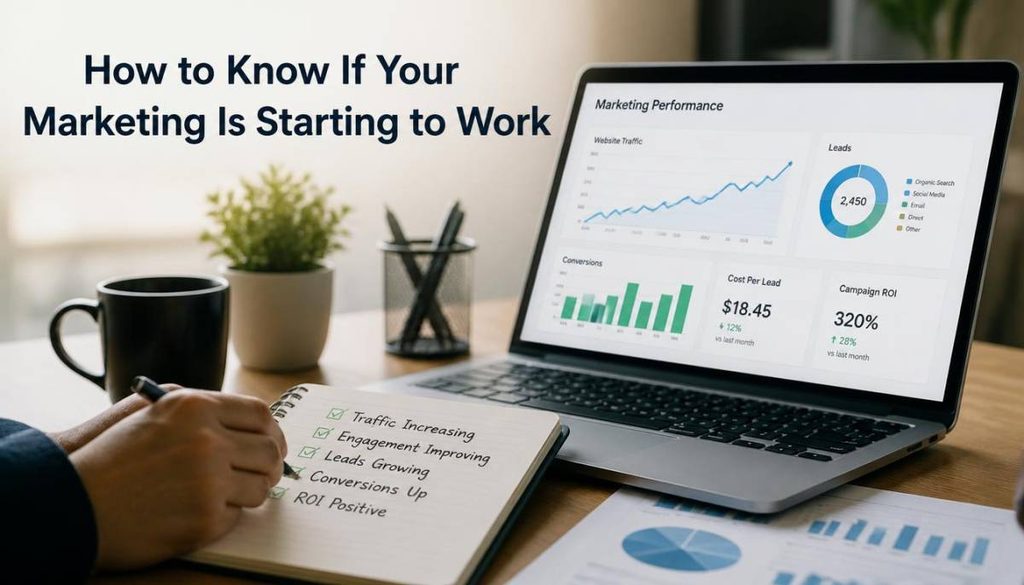
Successful marketing does not always mean that every post goes viral or every advertisement generates immediate sales. The more useful question is whether your marketing is moving the business toward its goals.
If you want brand awareness, look for growth in relevant reach and recognition. If you want leads, track qualified inquiries and the percentage that turn into customers. If you want profitable sales, examine revenue alongside advertising costs, margins, and other expenses.
Pay attention to the quality of results as well as their quantity. Ten relevant inquiries may be more valuable than a hundred messages from people who are unlikely to buy.
It is also important to establish realistic expectations. Results vary according to the industry, offer, competition, budget, and sales cycle. There is no single conversion rate or timeline that guarantees success for every business.
Choose a few meaningful indicators, review them regularly, and use the findings to guide your next decision.
Common Marketing Mistakes to Avoid
Even businesses with good products and capable teams can waste time and money through avoidable mistakes. Watch for these habits when reviewing your strategy.
Changing strategies too frequently: Constantly switching channels or offers makes it difficult to learn from your results. Make deliberate adjustments based on evidence.
Copying competitors without understanding your customers: Another business may have a different audience, budget, reputation, or sales process. Use competitors for inspiration, but build your approach around your own customers.
Spreading your budget too thin: Trying to run campaigns on every platform can leave you without enough resources to test and improve any of them properly. Start with the channels most relevant to your goal.
Focusing only on vanity metrics: Likes, followers, and impressions can provide useful context, but they do not automatically translate into leads or profit. Connect activity to business outcomes.
Ignoring customer feedback: Repeated questions, objections, complaints, and reasons for not buying can reveal exactly what your marketing needs to explain better.
Increasing spending before fixing the basics: More advertising will not necessarily solve an unclear offer, a poor landing page, or weak follow-up. Fix the underlying problem before investing more.
Frequently Asked Questions
Why is my marketing not generating leads?
Your marketing may be reaching the wrong audience, communicating an unclear offer, or failing to give people a compelling reason to get in touch. Review your targeting, message, landing page, and call to action. Also check whether your chosen channels reach people who are actively looking for what you offer.
Why am I getting website traffic but no sales?
Visitors may be interested in your topic but not ready to buy, or they may not understand your offer. Other possibilities include high prices, missing trust signals, poor mobile usability, unexpected costs, or a complicated checkout. Review visitor behavior and test improvements to the page most closely connected to the purchase.
Why are my social media posts getting no engagement?
Your content may not match your audience’s interests, provide enough value, or encourage meaningful interaction. Posting at a consistent pace can help, but frequency alone is not the solution. Experiment with useful tips, demonstrations, customer questions, and formats that suit your audience, then assess the quality of the response.
How long does it take for marketing to work?
The timeline depends on your channel, industry, budget, competition, and goal. Paid campaigns can generate early data quickly, while organic search and brand-building often take longer. Set a review period appropriate to your strategy, monitor progress, and make changes based on evidence rather than relying on an arbitrary deadline.
Should I stop running ads if they aren’t working?
Not necessarily. First, determine whether the problem is the audience, creative, offer, landing page, or conversion process. If the campaign is spending money without producing meaningful results, consider pausing or limiting it while you investigate. Do not keep spending simply because you hope performance will improve.
How can I improve my marketing without increasing my budget?
Begin by improving the activities you already pay for or spend time on. Clarify your message, update underperforming landing pages, answer customer questions through useful content, improve lead follow-up, and focus on channels that produce relevant results. Better execution can sometimes improve performance without requiring additional spending.
Turn Your Marketing Problems Into a Clear Action Plan
If you have been asking, “Why is my marketing not working?” the answer is unlikely to come from changing every part of your strategy at once. The most effective starting point is to identify the stage where you are losing potential customers and understand why it is happening.
You might need a clearer offer, a better-defined audience, a more useful website, or a stronger follow-up process. In other cases, the main issue may be that you are measuring activity rather than business results.
Choose the most important problem, make one focused improvement, and track what happens. When you use real performance data and customer feedback to guide your decisions, marketing becomes less about guessing and more about building a repeatable process for attracting, converting, and retaining customers.