| Period | Revenue | Expenses | Net Burn | Cash Balance | Status |
|---|
Most startups don’t die because the idea was bad. They die because they ran out of money before they had time to prove it was good.
That’s what runway is about. It’s not a finance term reserved for spreadsheet nerds — it’s the single most important number a founder should know at any given moment. How many months does your startup have left if nothing changes?
This guide walks you through exactly how to calculate startup runway, what affects it, how to extend it, and how to use our free Startup Runway Calculator to get a clear picture of your financial position right now.
What Is a Startup Runway?
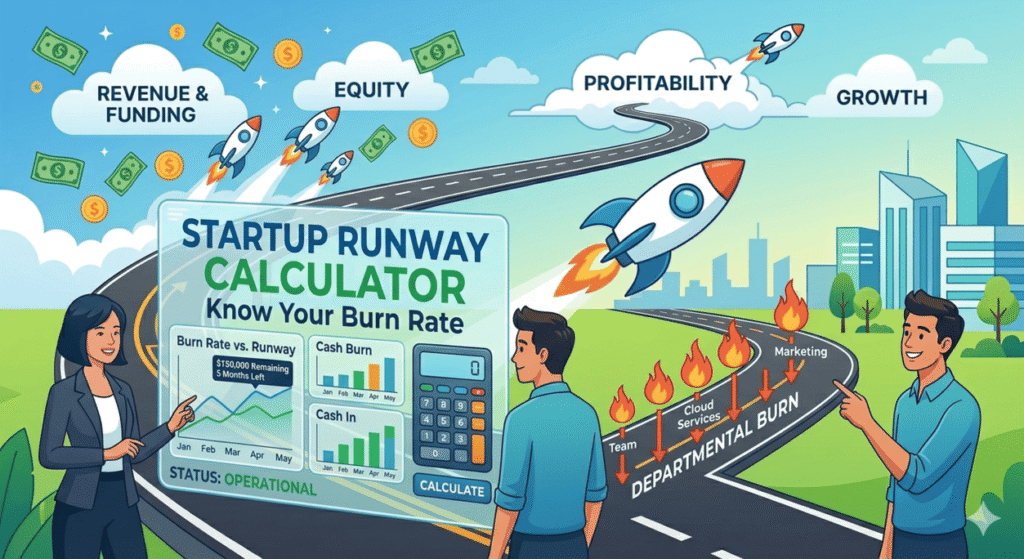
Startup runway is the number of months your company can continue operating before it runs out of cash, assuming current revenue and spending remain constant.
Think of it like fuel in a car. Your cash on hand is the tank. Your monthly burn rate reflects the speed at which you’re using up your resources. Runway tells you how far you can go before you need to stop and refuel — whether that means raising money, cutting costs, or generating enough revenue to sustain yourself.
The basic formula is:
Runway (months) = Cash on Hand ÷ Net Monthly Burn Rate
If you have $300,000 in the bank and your net burn is $30,000 per month, you have 10 months of runway.
Simple. But the real world is never that simple, which is why a dynamic calculator — one that accounts for revenue growth, expense scaling, and additional funding — gives you a far more accurate picture.
Key Terms You Need to Understand First
Before you punch numbers into any calculator, make sure you understand what each input actually means.
Cash on Hand
This is your total available cash — money sitting in your business bank account right now. Do not include receivables you haven’t collected, credit lines you haven’t drawn, or revenue you’re expecting but haven’t closed. Use only what’s in the account today.
Monthly Revenue
The actual cash your business collects each month. For SaaS businesses, this is your Monthly Recurring Revenue (MRR). For service businesses, it’s invoiced and collected revenue. Do not count projected sales or pipeline deals.
Monthly Expenses
Every dollar going out the door each month. This includes payroll, software subscriptions, rent, marketing spend, contractor fees, and any recurring obligations. Be honest here — founders routinely undercount expenses by forgetting annual fees, irregular payroll cycles, or ad spend that varies monthly.
Net Burn Rate
Your net burn is the difference between what you spend and what you bring in:
Net Burn = Monthly Expenses − Monthly Income
If you spend $50,000 and earn $20,000, your net burn is $30,000. If your revenue actually exceeds expenses, you’re cash-flow positive — congratulations, your runway is technically infinite.
Gross Burn Rate
Some investors ask about gross burn, which is simply your total monthly expenses regardless of revenue. It shows how much your operations cost before revenue contribution. Both numbers matter, but net burn is what actually determines your runway.
How to Use the Startup Runway Calculator
Our calculator above goes beyond the basic formula. Here’s how to use each input effectively.
Step 1: Enter Your Cash on Hand
Put your actual bank balance today. If you have multiple accounts, use the combined total. If you have a line of credit you’re planning to draw, you can factor that into the “Additional Funding” field separately.
Step 2: Enter Monthly Revenue
Use last month’s actual collected revenue, not ARR divided by 12 if your billing is uneven. Accuracy here matters more than optimism.
Step 3: Enter Monthly Expenses
Pull your last full month’s bank statement and total every outgoing payment. Include payroll taxes, not just gross salaries. Include software tools, subscriptions, freelancers — everything.
Step 4: Add Any Expected Funding
If you’ve already closed a round and the money is incoming, or you have a convertible note closing in the next 30 days, you can include that here. Do not include funding that’s “likely” or “in discussion” — only committed capital.
Step 5: Set Your Growth Assumptions
This is where the calculator gets powerful. You can choose from three scenarios:
- Bear: Conservative — low revenue growth (2%), expenses increasing faster (4%). Models a worst-case where growth stalls.
- Base: Realistic — 8% monthly revenue growth, 2% expense growth. Reflects a healthy early-stage trajectory.
- Bull: Optimistic — 15% monthly revenue growth, minimal expense creep. Models strong product-market fit momentum.
You can also manually adjust both sliders to match your specific situation.
Step 6: Read Your Results
The calculator gives you four instant outputs:
- Runway — how many months until cash hits zero
- Net burn per month — your current monthly cash loss
- Break-even month — when your revenue is projected to cover expenses
- Total cash — your available capital including any additional funding
The chart then plots cash balance, revenue, and expenses over 24 months so you can visually see where your runway ends — and where break-even intersects with your survival window.
What Your Runway Number Actually Means
Not all runway figures carry the same urgency. Here’s how to interpret what you’re seeing.
Less Than 6 Months — Critical
You are in the danger zone. At this point, fundraising should already be in progress because a typical seed or Series A round takes 3–6 months to close. If you don’t have a round underway, your priority right now is cutting burn and extending to at least 12 months. Read about the survival stage of business growth to understand the decisions that matter most in this phase.
6–12 Months — Caution
You have time, but not much margin for error. You should be actively fundraising or pushing hard toward break-even. This is also the time to look hard at your unit economics — if CAC payback is over 12 months, that’s a problem to fix before your next raise.
12–18 Months — Comfortable
This is the sweet spot. You have enough runway to build traction, iterate on the product, and enter fundraising conversations from a position of strength rather than desperation. Investors notice the difference.
18+ Months — Strong Position
You can be selective. You can set terms. You can walk away from bad deals. Founders with 18+ months of runway have significantly more negotiating leverage and typically raise at better valuations with cleaner terms.
6 Proven Ways to Extend Your Startup Runway
Knowing your runway is step one. The next step is actively managing it.
1. Increase Revenue Faster Than You Increase Spending
The most obvious lever, but the most underutilized. Every dollar of new revenue you add reduces your net burn by the same amount. If you can grow revenue 10% month over month without proportionally growing expenses, your runway compounds quickly. Focus obsessively on your fastest, cheapest acquisition channel first.
2. Audit Expenses Monthly — Not Quarterly
Most founders do an expense review when something feels wrong. By then, you’ve already lost two or three months of overspending. Set a recurring calendar block every first Monday of the month to review every recurring charge. Cancel anything that isn’t directly tied to revenue or customer delivery.
3. Renegotiate Your Biggest Costs Early
Payroll is typically the largest expense. Before you consider layoffs, explore whether senior team members would accept a temporary salary reduction in exchange for equity. Many will, especially early employees who are mission-aligned. Landlords and software vendors are also often willing to negotiate during lean periods — you just have to ask.
4. Shift to Annual Billing
If you offer subscriptions, adding an annual billing option at a 15–20% discount can inject meaningful upfront cash. One month where 30% of your customers switch to annuals can add several months of runway without changing your burn at all.
5. Explore Non-Dilutive Funding
Not all capital requires giving up equity. Revenue-based financing, government startup grants, R&D tax credits, and SMB lending programs can extend your runway without diluting your cap table. These sources take time to access, so research what’s available in your country now, not when you’re desperate.
6. Use a Sensitivity Analysis to Find Your Breaking Point
Your runway forecast is only as good as your assumptions. A startup financial sensitivity analysis stress-tests what happens if one key variable moves — say, CAC doubles or a major customer churns. Knowing your breaking point in advance lets you create contingency plans before the crisis hits.
Common Mistakes Founders Make With Runway Planning
Confusing Gross and Net Burn
Investors typically ask about both. When you report gross burn without knowing the distinction, it creates doubt about your financial awareness. Know both numbers cold.
Counting Revenue That Hasn’t Been Collected
Signed contracts, invoices sent, and verbal commitments are not cash. They don’t appear in your runway calculation until the money is in the account. Founders who count uncollected revenue routinely underestimate how tight their situation is.
Not Updating the Model Monthly
A runway calculation from three months ago is nearly useless. Your burn rate changes every time you hire, every time you run a campaign, every time a customer churns. Update your numbers every month as part of your financial close process.
Planning for “Average” Performance
Averages are dangerous in runway planning. A month where a major customer delays payment, an unexpected AWS bill arrives, or a planned revenue event doesn’t close can punch a significant hole in your cash position. Always model a downside scenario, not just your expected case.
Fundraising Too Late
Founders often start raising when they have 4–5 months of runway left. That’s already too late. The fundraising process — investor outreach, meetings, due diligence, term sheet, close — routinely takes 3–6 months for a seed round and longer for Series A. Start conversations when you have 12–15 months of runway. Read more about timing your raise in our guide to the startup bootstrapped fundraising strategy.
When to Hire a Fractional CFO to Manage Runway
At some point — usually around the time your burn exceeds $50,000 per month or you’re preparing for a significant raise — managing runway with a spreadsheet and intuition stops being sufficient.
A Fractional CFO brings structured cash flow forecasting, burn rate management, and investor-ready reporting to early-stage companies without the cost of a full-time hire. They build the weekly cash update routines, the 13-week rolling forecasts, and the KPI dashboards that make your financial position legible to both your leadership team and your investors. If you’re approaching a funding round, learn more about when and how to bring in a fractional CFO for your startup.
Runway by Stage: What’s Normal?
Different stages of business call for different runway expectations.
| Stage | Recommended Runway | Priority |
| Pre-seed | 12–18 months | Prove the problem is real |
| Seed | 18–24 months | Reach repeatable sales |
| Series A | 24+ months | Build systems and scale |
| Growth stage | 18–24 months | Expand without breaking the core |
These benchmarks come from the 7 stages of business growth framework, which maps each phase of a company’s development to the financial and operational priorities that matter most at that moment.
Conclusion
Runway is not a passive number you calculate once and forget. It’s an active signal — one that should shape how you hire, how you spend, how you sell, and when you raise.
The founders who build durable companies are not always the ones with the best product or the biggest market. They’re often the ones who understood their cash position clearly, made hard decisions early, and gave themselves enough time to find what worked.
Use the calculator at the top of this page today. Update it every month. Share it with your co-founders. And whenever a major financial decision is in front of you — a new hire, a marketing push, an expansion into a new channel — run the numbers first.
Time is the one resource a startup can never buy back. Protect it accordingly.
Frequently Asked Questions
What is a good startup runway?
Most investors and advisors recommend having at least 18 months of runway at any given time. This gives you enough buffer to fundraise without urgency, iterate on the product, and react to unexpected setbacks. Less than 12 months puts you in reactive mode; less than 6 months is a crisis requiring immediate action.
What is the difference between burn rate and runway?
Burn rate is how much cash you spend each month (net of revenue). Runway is how many months your current cash balance lasts given that burn rate. Burn rate is the speed; runway is the distance remaining. Reducing burn rate directly extends the runway.
How often should I recalculate my startup’s runway?
At minimum once a month, immediately after your monthly financial close. If you’re in a high-spend period — hiring, launching a campaign, entering a new market — recalculate weekly. Stale runway numbers lead to decisions made on false assumptions.
Can revenue growth extend the runway significantly?
Yes — and this is one of the most underappreciated dynamics in early-stage finance. Because revenue directly offsets expenses, even modest month-over-month revenue growth compounds quickly. A startup growing revenue at 10% per month while holding expenses flat can more than double its effective runway within 12 months compared to a flat-revenue scenario.
What counts as cash on hand for runway calculation?
Only money that is currently in your business bank account and available to spend. Do not include accounts receivable, committed but unclosed funding rounds, credit lines you haven’t drawn, or revenue you expect to close. Conservative inputs give you an honest picture — optimistic inputs give you a false sense of security.