Running a company with disjointed apps can be like trying to cook dinner in five different kitchens. Data resides across email, spreadsheets, CRM and accounting tools, project management software. The reporting is slow and the busywork accumulates.
That’s why US teams are making AI-powered business-management applications their go-to in 2026. So if the finance team is connected to sales and operations and analytics, you get one version of the truth, decisions faster, and less busy work. Today’s AI business automation tools tack on forecasting, routing and summaries, so people don’t have to waste as much time chasing updates.
The guide then walks you through what to look for and shows top AI cloud business management platform tools worth comparing, as well as how to choose the best fit in an easy way.
What to look for before you pick an AI cloud business management platform
Cloud apps connect core business systems and automation flows across teams, created with AI.
Most “platform” demos look great. The hard part is what happens after go-live, when real data arrives and teams need answers now. Before you compare AI SaaS business platforms or cloud ERP solutions, decide what job the system must own. Is it pipeline speed, close control, inventory accuracy, or cloud spend?
Also, plan for messy reality. You’ll import half-clean data. Teams will ask for exceptions. Executives will want dashboards next week. A good platform handles that without turning into an admin-only maze.
If you want a practical way to judge how deep a vendor’s AI really goes (assistive vs more automated), use this internal framework on AI SaaS product classification criteria. It helps you compare tools based on what they actually do, not how they’re marketed.
For extra market context, this roundup of AI cloud business management platform tools in 2026 is useful as a second opinion, especially when building an initial longlist.
The must-have basics, cloud reliability, security, and easy integrations
Start with reliability and trust. Ask about uptime history, incident response, and backup and recovery. Then confirm encryption in transit and at rest, plus role-based access so people only see what they should. For regulated work, you’ll also want audit logs, SSO, and clear compliance documentation.
Next, focus on integrations because that’s where platforms win or fail. Your cloud-based business management platforms should connect to the tools you already rely on, like email, accounting, ecommerce, HR, and your data warehouse. Prebuilt connectors save time, but APIs matter for anything custom. Finally, confirm data export options so you don’t get trapped in a new silo.
How to judge the AI, automation you can trust, not just fancy features
“Good AI” in AI-driven enterprise software feels calm and grounded. It gives recommendations you can explain, flags confidence levels, and supports human approval steps. It also logs what it did and why, which matters when finance or IT asks for proof.
Look for AI features that map to real outcomes: forecasting, lead scoring, anomaly detection, expense auto-categorization, workflow routing, AI analytics for business, and AI assistants that summarize work.
If a vendor can’t show guardrails, logging, and approval controls, assume the automation will create new cleanup work later.
Generative AI can also hallucinate. That’s not a deal-breaker, but it means you should test with real scenarios and make sure risky actions require approval.
Top AI cloud business management platform tools worth comparing
This section is a focused shortlist of tools that show up often in 2026 buying cycles, spanning AI CRM cloud platforms, intelligent ERP systems, and smart business operations platforms.
Salesforce Einstein, AI CRM that helps sales and service teams move faster
Salesforce Einstein fits best when your company lives inside CRM and needs speed. It’s strong for AI workflow management systems tied to selling and support, where small improvements can compound into pipeline lift.
- Best for: Sales, service, and revenue ops teams that want faster follow-up and cleaner CRM data
- Standout AI features: Lead scoring, pipeline forecasting, next-best actions, service chatbots, sentiment insights, AI-driven dashboards
- Limitation to watch: Cost and admin complexity can rise quickly as you scale
Microsoft Dynamics 365 with Copilot, a smart cloud ERP and CRM combo
Dynamics 365 is attractive when you want connected sales, finance, and operations in one ecosystem, especially if you already pay for Microsoft 365. Copilot-style help can reduce time spent writing summaries and chasing task updates.
- Best for: Teams standardizing on Microsoft across CRM plus finance and ops
- Standout AI features: In-app summaries, draft content, task assistance, cross-app insights across ERP and CRM modules
- Limitation to watch: Implementation can take time, and partner quality matters a lot
Oracle Fusion Cloud, intelligent ERP for complex finance and supply chain
Oracle Fusion Cloud is built for large, multi-entity organizations that need deep controls and strong governance. It’s a common pick when finance and supply chain complexity drive the buying decision.
- Best for: Enterprise finance, HR, procurement, and AI inventory management systems at scale
- Standout AI features: Real-time analytics, exception handling, automated approvals, planning support across finance and supply chain
- Limitation to watch: Heavier setup, it can be more platform than smaller teams need
Zoho One with Zia AI, an all-in-one platform for growing small businesses
Zoho One is a practical choice when you want broad coverage without enterprise-level overhead. It brings CRM, finance, marketing, help desk, and ops together, with AI that supports automation and insights for everyday work.
- Best for: SMBs that want all-in-one value and quick setup
- Standout AI features: AI suggestions, workflow automation, assistive insights across the suite (CRM, finance, support)
- Limitation to watch: Some advanced enterprise controls can be lighter than the largest suites
IBM Turbonomic, AI that cuts cloud waste and keeps apps running well
Turbonomic is not a full ERP or CRM. Instead, it’s one of the smart business operations platforms teams use to control cloud performance and cost across major clouds. If cloud spend is rising faster than revenue, it’s worth a look.
- Best for: FinOps, IT ops, and platform teams managing multi-cloud resources
- Standout AI features: Automated resource sizing, policy-based actions, cost optimization tied to app performance
- Limitation to watch: You’ll still need separate AI financial management software and CRM/ERP systems for core business processes
If you want a wider scan beyond this shortlist of top AI cloud business management platform tools, this list of AI cloud business management platforms to boost productivity can help you spot adjacent categories you may have missed.

Estimated Price Ranges for AI Cloud Business Management Platforms (2026)
Pricing varies based on users, modules, AI depth, integrations, and implementation scope. These ranges provide a realistic budgeting starting point.
Salesforce Einstein (CRM + AI Layer)
Estimated range: $130–$325 per user per month
- Advanced forecasting and automation usually require higher-tier plans
- Add-ons and integrations increase total cost
- Best budget expectation: Mid-to-high enterprise SaaS investment
Microsoft Dynamics 365 with Copilot
Estimated range: $75–$210 per user per month
- Core modules start lower; AI features increase pricing
- Ecosystem alignment can reduce integration costs
- Best budget expectation: Mid-market to enterprise
Oracle Fusion Cloud (ERP Suite)
Estimated range: Custom enterprise pricing
- Contracts typically range from low six figures to multi-million annually
- Designed for complex global operations
- Best budget expectation: Large enterprise investment
Zoho One with Zia AI
Estimated range: $40–$95 per user per month
- All-in-one predictable pricing
- AI embedded across CRM, finance, and support apps
- Best budget expectation: SMB-friendly suite
IBM Turbonomic (AI Cloud Optimization)
Estimated range: $15,000–$150,000+ per year
- Based on infrastructure footprint
- Not priced per user
- Best budget expectation: IT / FinOps operational spend
A simple way to choose the right tool for your business size and goals
You don’t need a six-month selection process to make progress. First, write down the one workflow that hurts most. Next, shortlist 2 to 3 tools that are built to own it. Then run a pilot that proves value with real data.
Here’s a quick “shortlist in one hour” method: pick your primary system of record (CRM-first, ERP-first, or cloud ops-first), list the three must-have integrations, and define one metric that matters to finance (time saved, errors reduced, faster close, better forecast accuracy, or lower cloud spend).
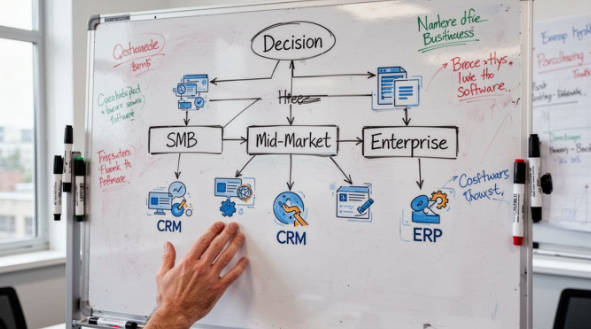
Match the platform to your stage, SMB, mid-market, or enterprise
This simple table helps align needs to platform depth.
| Stage | What matters most | Common buying trigger |
| SMB | Fast setup, all-in-one value, simple automation | Replacing spreadsheets, too many disconnected apps |
| Mid-market | Strong automation, better reporting, cleaner data flow | Consolidating tools, needing better forecasting |
| Enterprise | Governance, global finance, deep integrations, security | Standardizing processes, audits, complex supply chain |
Run a 30-day pilot that proves ROI, automate one workflow end to end
Pick one end-to-end process and automate it using business process automation software features inside the platform. Good candidates include quote-to-cash, invoice processing, lead-to-deal, purchase approvals, or inventory reorder points.
Define success before you start: time saved per week, fewer errors, faster close, forecast improvement, or cost reduction. During demos, ask five blunt questions: who owns the data, what gets logged, how approvals work, how much admin effort it takes, and what total cost looks like after year one.
For a broader background on AI tooling categories, this directory of best AI platforms in 2026 can help you separate “AI layer” platforms from full business suites.
Conclusion
The best platform isn’t the one with the most features. It’s the one that fits your main job to be done, whether that’s CRM speed, ERP control, all-in-one simplicity, or cloud cost optimization. Shortlist 2 to 3 options, then run a small pilot with real data and measurable success metrics. Before your next demo, write down one process you want to automate first, and bring that exact workflow to every vendor conversation.
Frequently Asked Questions About AI Cloud Business Management Platforms
What is an AI cloud business management platform?
An AI powered cloud business management platform that enables businesses to unite all functions, including CRM, ERP, finance and operations into a single system optimized for constant reinvention with intelligence embedded.
What is the price for AI business management software in 2026?
Prices can vary from $40 per user per month for all-in-one sets geared toward small businesses to six-figure annual contracts for enterprise-level extranets and ERP packages.
Are AI powered ERP better than traditional ERPs?
What AI ERP systems bring to the table is in forecasting, anomaly detection and workflow automation, which will eliminate manual work and enhance reporting accuracy.
What is the best platform for small businesses?
Built-in AI and predictable pricing in an all-in-one platform is usually best for SMBs wanting to get up and running quick and easy.