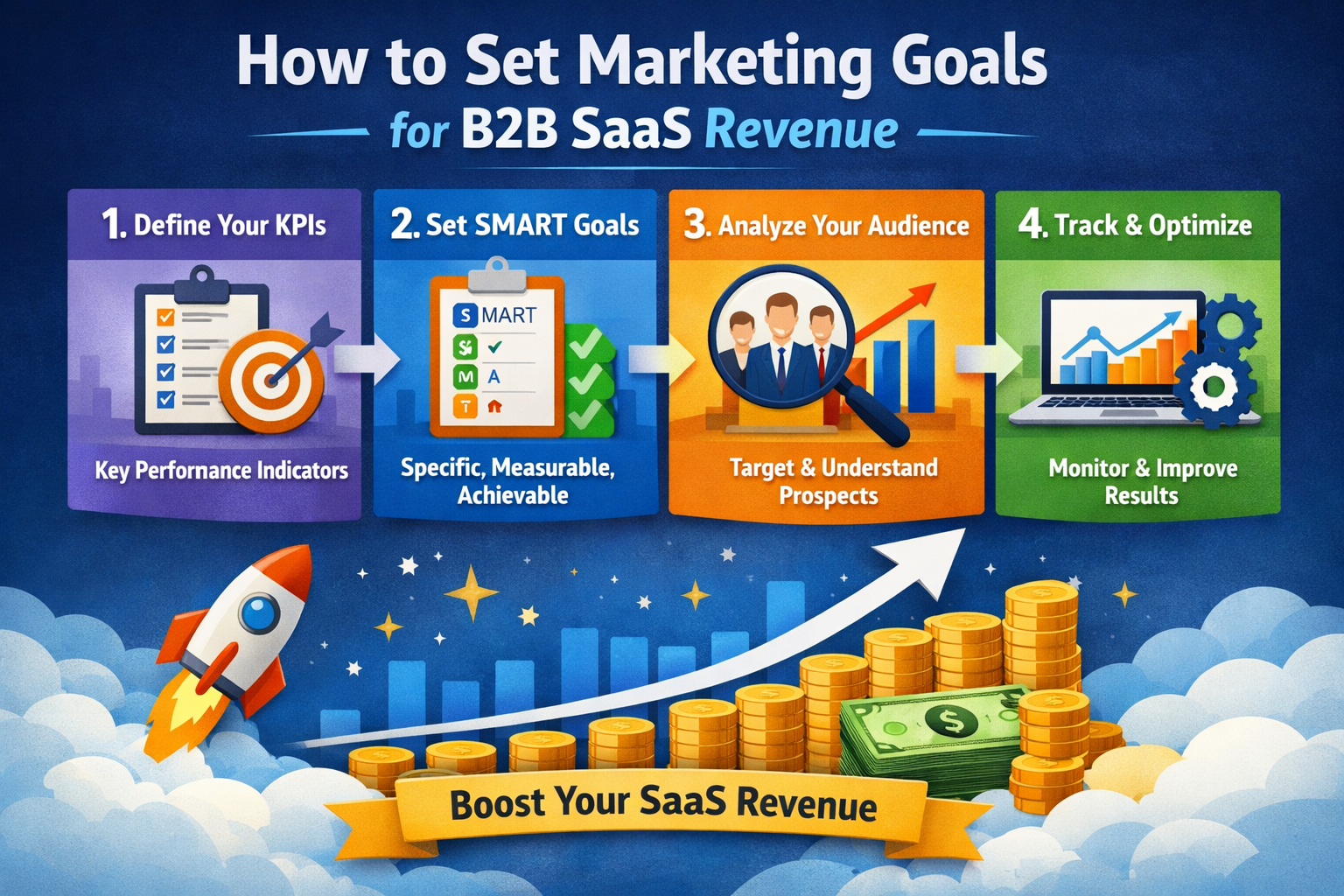
If your B2B SaaS company is hitting traffic goals but missing revenue targets, the problem isn’t effort — it’s alignment.
In SaaS, attention doesn’t equal growth. Recurring revenue does. Long sales cycles, multi-stakeholder buying committees, product adoption, renewals, and expansion all influence whether marketing actually drives ARR.
That’s why setting marketing goals for B2B SaaS revenue requires a different approach than traditional B2B marketing.
This guide walks you through a revenue-driven framework for B2B SaaS marketing goals. You’ll learn how to:
Translate ARR or MRR targets into pipeline numbers
Align marketing KPIs with sales outcomes
Set lifecycle goals across acquisition, activation, and retention
Build quarterly marketing OKRs tied directly to revenue
When marketing goals connect to revenue mechanics, forecasting improves, CAC stabilizes, and churn becomes manageable.
Think of goal-setting like wiring a house. Pretty light switches do nothing if they don’t connect to the panel. Your marketing goals must connect to revenue.
How B2B SaaS Marketing Goals Differ From Traditional B2B
Traditional B2B companies often focus on lead volume and quarterly sales quotas. B2B SaaS companies operate differently because revenue compounds — or shrinks — every month.
In SaaS:
Revenue is recurring, not one-time
Retention matters as much as acquisition
Activation impacts close rates
Expansion revenue reduces CAC pressure
Net Revenue Retention (NRR) defines long-term growth
This means marketing cannot stop at generating MQLs. It must influence:
Pipeline quality
Sales velocity
Customer onboarding success
Product adoption
Upgrade intent
If your goals ignore churn and expansion, you are planning for flat growth.
Vanity Metrics Do Not Pay for Churn
High lead volume can coexist with low SQL rates, weak close rates, and high CAC. A dashboard can look “green” while MRR stays flat.
Use one rule of thumb: if a metric can’t be tied to pipeline or retention, it can’t be a primary goal. You can still track it, but it should not be what you celebrate.
Marketing and Sales Misalignment Breaks Revenue Forecasting
Revenue forecasting fails when you don’t share definitions and service levels. If “MQL” means “downloaded a PDF” to marketing but “not a buyer” to sales, you will overestimate pipeline and burn trust.
Align on shared stages (TOFU, MOFU, BOFU), document the handoffs, and keep one pipeline view in your CRM. Smarketing is not a meeting, it’s agreement on what counts and what happens next.
A Revenue-Driven B2B SaaS Marketing Goal Framework That Covers the Full Customer Lifecycle
Acquisition Goals: Building Predictable Sales Pipeline
Acquisition in B2B SaaS is not about generating leads — it is about generating qualified pipeline.
Pipeline represents the total dollar value of sales-accepted opportunities that marketing helps create. It is the clearest leading indicator of future revenue.
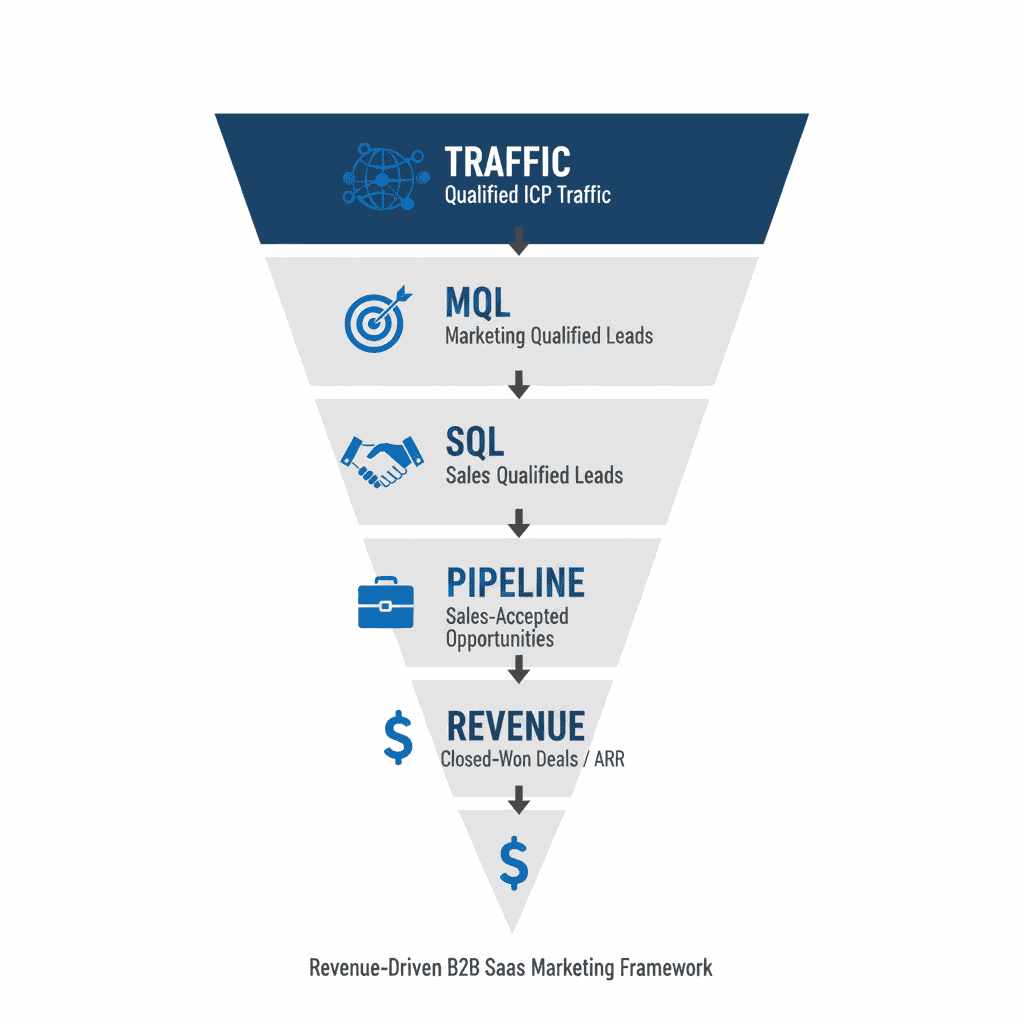
Start with a pipeline target, then choose channels.
Your acquisition goals should focus on:
Sales-accepted pipeline dollars
Number of SQLs created
MQL-to-SQL conversion rate
Sales-accepted rate
Cost per SQL
Pipeline coverage ratio (typically 3x revenue target)
Lead Velocity Rate (month-over-month pipeline growth)
If revenue is the outcome, pipeline is the input. Marketing does not own revenue directly — but it must build predictable pipeline that supports it.
Activation and Adoption Goals for Product-Led Growth and Trials
Activation goals reduce sales friction. If buyers reach value before a sales call, your close rate improves and sales cycles tighten.
Common activation targets include onboarding completion, reaching a first-value event (for example, first integration connected), and feature adoption for key use cases. For PLG motions, define PQL thresholds from usage, not from form fills.
Retention and Expansion Goals That Protect ARR and Grow LTV
Retention is marketing’s concern because your messaging, education, and customer programs shape adoption.
Set goals tied to churn rate, expansion MRR, and NRR. Run onboarding emails, customer education sequences, webinars for current users, and account-based programs for upgrades. If you are not setting goals to reduce churn, you are planning to replace lost revenue every month.
High-performing B2B SaaS companies often target Net Revenue Retention (NRR) above 110% and CAC payback between 12 and 18 months. These benchmarks force discipline across acquisition efficiency, onboarding speed, and expansion strategy. If your goals do not pressure both growth and efficiency, your framework is incomplete.
How to Set Marketing Goals for B2B SaaS Revenue by Working Backward
This is where aligning marketing goals with SaaS revenue becomes concrete. You do not start with “publish 12 blogs.” You start with the revenue number, then work down to what marketing must produce.
Start with your ARR or MRR target, then work backward to required pipeline.
Use plain assumptions: target new MRR, average contract value (ACV), close rate, and sales cycle length. Then calculate deals and pipeline.
Example for a small team:
| Input | Assumption | Output |
|---|---|---|
| Target new MRR (per month) | $30,000 | |
| Average new customer MRR | $1,500 | 20 deals needed |
| Close rate from SQL | 20% | 100 SQLs needed |
| Pipeline coverage | 3x | $450,000 qualified pipeline |
If sales cycles are about 90 days, you must build that pipeline early, not in the last month of the quarter. This is why revenue-driven marketing goals must include timing, not just totals.
Map the Funnel and Pick the Few KPIs That Matter at Each Stage
TOFU: qualified traffic from your ICP, percent of visits from target industries, cost per qualified visit (for paid).
MOFU: MQL-to-SQL rate, sales-accepted rate, cost per SQL.
BOFU: demo-to-close support metrics (show rate, sales cycle influence), win rate influence for marketing-sourced deals.
Lifecycle: activation rate, churn, expansion MRR, NRR.
Write definitions down. An SQL should mean the same thing to marketing, sales, and RevOps. A PQL should be based on usage that predicts conversion, not curiosity clicks.
Turn the Plan into SMART Goals and Marketing OKRs You Can Review Each Quarter
OKRs work best when the objective is a business outcome and key results are measurable.
Examples you can adopt:
Objective: Create a predictable pipeline for the Q2 revenue target.
Key results: generate $450,000 in sales-accepted pipeline, reach 100 SQLs, keep cost per SQL under $450.
Objective: Improve trial-to-paid conversion through activation.
Key results: raise activation rate from 35% to 50%, reduce time-to-first-value from 3 days to 1 day, create 60 PQLs per month.
One SMART goal example: “By end of Q2, increase MQL-to-SQL conversion from 18% to 25% by tightening ICP targeting and adding a 15-minute follow-up SLA.”
Tools, Templates, and Review Habits That Keep Goals on Track
You do not need a complex stack, you need clean data. At minimum, you need a CRM for pipeline stages, product analytics for activation signals, and a dashboard you trust.
Use a one-page planning template: revenue target, funnel assumptions, KPI targets, campaign bets, owners, and review cadence. Run monthly checks for pacing and a quarterly reset for targets. Keep UTM rules consistent so you do not argue about attribution instead of fixing the funnel.
Common Goal-Setting Mistakes That Quietly Lower SaaS Revenue
The first mistake is setting too many goals. Limit yourself to the few numbers that drive revenue, then let tactics change underneath them.
The second mistake is moving targets mid-quarter without updating assumptions. If ACV drops or sales cycle length increases, revise the math and communicate it.
The third mistake is ignoring retention. If churn rises, your net growth stalls even with strong acquisition.
The fourth mistake is trusting unverified attribution. If your data is messy, focus on stage conversion rates and sales-accepted pipeline first.
Review goals with sales and customer success, because they see problems early.
Conclusion
You set better goals when you treat marketing like a revenue system, not a content calendar. Revenue-driven marketing goals cover acquisition, activation, and retention, then roll down from ARR and MRR into funnel-based marketing goals B2B SaaS teams can track weekly. When you work backward from revenue and keep definitions tight, forecasting improves and friction drops.
Pick one revenue target for this quarter, write one set of funnel assumptions, then commit to 3 to 5 KPIs you will review every week. Consistency beats reinvention.