Most owners think growth looks like a steady climb. It doesn’t. It’s more like building a house while you’re already living in it, with a few storms in between.
That’s why the 7 stages of business growth are useful. They don’t predict your future, but they help you spot what matters right now (cash, customers, systems, people) so you stop copying what bigger companies do. Each stage has a different “main problem,” and the wrong fix can waste months.
Also, businesses don’t move through stages at the same speed. Some fly, some crawl. After a pivot, a new product, or a market shift, you might repeat earlier stages, just with better instincts.
Photo by RDNE Stock project
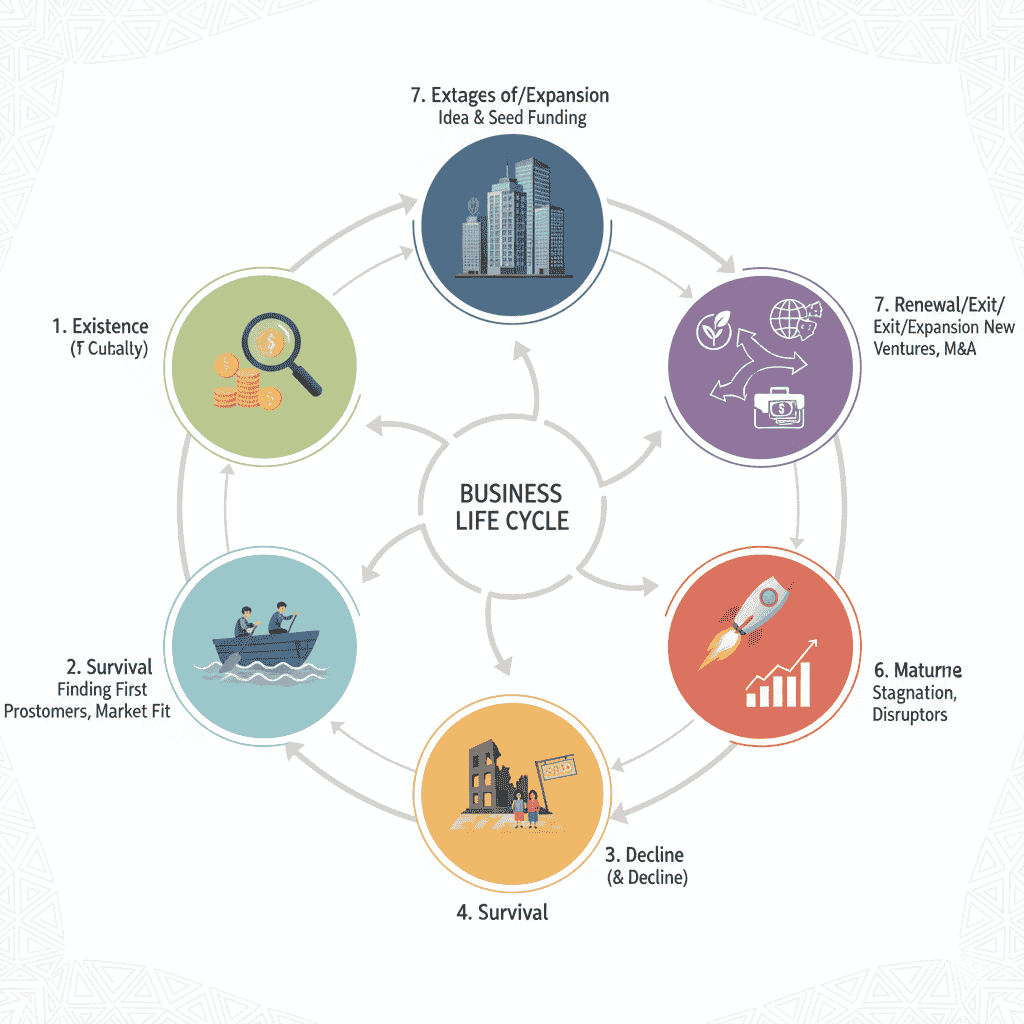
An at-a-glance view of a business moving from early validation to renewal, created with AI.
The 7 stages of business growth, explained with clear goals and warning signs
These business life cycle stages show up across industries, even if people rename them. Think of them as organizational growth stages that repeat whenever your business model changes.
If you want a second viewpoint on how stage-based planning works, Salesforce’s summary of stages of business growth for small businesses is a solid reference.
Stage 1: Seed stage, prove the problem is real
This is the idea and validation stage. You’re talking to real people, running small tests, and trying to learn what they’ll pay for (not what they say they want). The main goal is proof, not polish.
Common mistakes: building too much too soon, skipping customer interviews, and pricing that’s fuzzy or inconsistent. Quick win: schedule five customer calls this week and ask for a commitment (pre-order, deposit, or waitlist signup). Simple metric: number of real customer conversations that include a specific problem and a specific price.
Pricing confusion shows up early, so a simple tool like a SaaS pricing calculator tool can help you sanity-check numbers if you’re selling subscriptions.
Stage 2: Startup phase, launch and get your first repeat customers
Now you’re selling for real. You’re learning what customers actually buy, how long it takes to close, and what it costs to deliver. The main goal is repeatable sales, not viral attention.
Common mistakes: chasing every type of customer, making a weak offer (too broad, too many options), and ignoring margins until it’s “too late.” Quick win: pick one offer and one acquisition channel for 30 days. Metric: weekly sales from your main channel or repeat purchase rate, depending on your model.
In 2026, many founders will use lightweight AI tools to draft outreach and test ads faster, but it still comes down to a clear offer.
Stage 3: Survival stage, stop the cash leaks and stabilize operations
This stage isn’t glamorous. It’s about staying alive. Revenue exists, but it’s uneven, costs creep up, and delivery problems create refunds, churn, or bad reviews. The main goal is stability.
Common mistakes: hiring too fast, discounting to “buy” growth and killing profit, and messy billing (late invoices, unclear terms). Quick win: build a weekly cash forecast you update every Monday. Metric: cash runway (weeks of expenses covered) plus an operations metric like on-time delivery rate.
If you want a deeper method for pressure-testing assumptions behind the runway, this guide on startup financial sensitivity analysis is a practical way to spot what breaks first.
Stage 4: Growth phase, build systems so the business stops depending on you
This is one of the scaling stages of a business that surprises owners. You can sell, but now you must deliver at volume without quality dropping. The main goal is systems and delegation.
Common mistakes: no documented process, weak onboarding, and the founder doing every approval (which turns you into a bottleneck). Quick win: document one core workflow end-to-end (sales handoff, fulfillment, support). Metric: owner hours spent on delivery work vs leading work each week. If “delivery” always wins, growth stays fragile.
Stage 5: Expansion stage, grow into new markets without breaking what works
These business expansion stages look like new locations, new product lines, new segments, or big partnerships. The main goal is controlled testing, because expansion multiplies complexity.
Common mistakes: expanding before the core is profitable, underestimating support and training, and ignoring local market differences (pricing, seasonality, buyer behavior). Quick win: run a small pilot with a tight budget and a clear stop rule. Metric: profit per new location or product line after 90 days (not just revenue).
For a small business friendly perspective on financing and planning across stages, Accion Opportunity Fund’s guide to navigate the 7 stages adds useful context.
Stage 6: Maturity stage, defend your spot and keep improving
Business maturity stages bring steadier performance, more competition, and fewer “easy wins.” The main goal is protecting your advantage while improving margins through better ops.
Common mistakes: getting comfortable, letting the product get stale, and skipping employee development. Quick win: refresh your top three customer pain points, then fix one this quarter. Metric: customer retention rate and net profit margin. If retention slips, you’ll feel it before revenue drops.
Stage 7: Renewal or exit stage, decide what comes next
At this point, you choose: renew (new offer, new model, new tech), hold steady as a lifestyle business, merge, sell, or wind down. The main goal is intentional direction, not drifting.
Common mistakes: waiting too long to change, ignoring new competitors, and having no succession plan. Quick win: do a “dependency audit” and list what breaks if you step away. Metric: share of revenue from new products/services in the last 12 months, or an owner dependency score (can the business run two weeks without you?).
If you’re comparing different versions of the business life cycle, this write-up on the 7-stage business life cycle is another helpful frame.
How to figure out your stage fast, and what to focus on this quarter
Here’s the quick self-check: money, customers, systems, people. Which one is the tightest constraint right now? That’s usually your real stage, even if your revenue looks “ahead.”
A simple stage-to-focus map for business development stages:
- Seed equals validation and pricing clarity
- Startup equals a repeatable offer and one acquisition channel
- Survival equals cash control and reliable delivery
- Growth equals process, hiring, and basic dashboards
- Expansion equals pilots, training, and protecting the core
- Maturity equals retention, margins, and continuous improvement
- Renewal/exit equals strategy, sustainability, and owner independence
Three rules keep it practical: fix the bottleneck, pick one growth lever, and track one to two numbers weekly. Most teams don’t need more data, they need fewer metrics that actually drive action.
A quick stage check using simple yes/no questions and a couple of key metrics, created with AI.
A simple stage check you can do in 10 minutes
Answer yes or no:
- Do we have repeat customers (or repeat referrals) each month?
- Do we know our gross margin on the main offer?
- Is cash runway predictable for the next 8 weeks?
- Are the main tasks documented (sales, delivery, support, billing)?
- Can someone else handle customer issues without me stepping in?
Pick the stage that matches the biggest current constraint, not the stage you wish you were in. If cash is tight, you’re not “expanding,” you’re in survival, even if your follower count says otherwise.
What changes as you move up the business life cycle stages
Early on, you’re doing the work and selling the work. Then you manage people and projects. Later, you lead: setting priorities, building leaders, and making calls that shape the next two years.
The order matters. Selling comes first. Then cash control. Then systems. Then leadership and strategy. When you try to skip steps, the business usually pulls you back.
Conclusion
The stages are a map, not a scorecard. Moving “up” isn’t about ego, it’s about solving the right problem at the right time. If you name your current stage honestly, you can stop chasing random tactics and start building momentum.
Pick one goal for the next 90 days, then choose one simple metric to watch weekly. Keep it boring and consistent. That’s how revenue growth becomes predictable, and how scaling stops feeling like a constant emergency. Your next stage will show up faster when you focus on the constraint in front of you, not the company you’re trying to imitate.