Startup Bootstrapped Fundraising Strategy: Build Traction First, Raise on Better Terms (2026)
If fundraising feels harder in 2026, you’re not imagining it. In the US, many investors have become pickier, and they want proof that customers will pay before they commit.
According to recent reports from PitchBook and Crunchbase, seed deal volume has cooled compared to peak years, and median time to close a round has increased. Investors are prioritizing revenue, capital efficiency, and shorter payback periods over growth-at-all-costs narratives.
A startup bootstrapped fundraising strategy is a simple idea: you fund early growth with customer revenue and disciplined cash habits first, then you raise outside money only when it clearly speeds up what’s already working. In other words, you earn your way into better options.
This post breaks it into three parts. First, how to get to early revenue without burning cash. Next, the non-VC funding options that can help when bootstrapping hits a wall. Finally, how to raise a small round from a position of strength, with clean numbers and real traction.
Start by funding growth with customers, not investors
Bootstrapped traction isn’t about moving slowly. It’s about moving with accuracy. When customers pay early, you get two benefits at once: cash and proof. That proof later shows up in better terms, less dilution, and fewer “come back when…” conversations.
Track a few numbers from week one, even if they’re small:
- MRR (monthly recurring revenue): how much subscription revenue you expect each month.
- Retention (or churn): do customers stay, or do they cancel quickly.
- Payback period: how long it takes to earn back what you spent to get a customer.
- Gross margin: for every dollar you earn, how much you keep after direct costs.
You don’t need perfect spreadsheets. You need honest signals.
If you’re unsure how to connect marketing efforts directly to revenue metrics, define revenue-linked goals early so your traction compounds instead of drifting.
Pick one sales channel, get your first 10 paying customers, and learn fast
Early on, focus beats variety. If you try five channels, you won’t run any of them long enough to learn what works. Pick one that matches your product and your comfort level, then commit for 30 days.
Good bootstrap-friendly channels include LinkedIn outreach, direct sales to a tight niche, and niche communities where buyers already talk shop. Don’t aim for “awareness.” Aim for conversations that end in a yes or a no.
A simple weekly routine keeps you moving:
- Outreach (daily): 20 to 40 targeted messages to the same buyer type.
- Demos (2 to 4 per week): show the product and ask where it breaks.
- Follow-ups (daily): most deals close after the second or third touch.
- Customer interviews (1 to 2 per week): confirm the real pain and test pricing.
By customer number 10, you should know what you sell, who buys, and what they say right before they pay.
Use lightweight MVPs and AI tools to keep costs low while you ship
Your MVP should feel like a sturdy canoe, not a cruise ship. Build the smallest version that delivers the core result, then improve based on actual usage. This is how micro tools win, and it’s also how many service founders productize later.
AI can help you stay lean, as long as you don’t add tools like collectibles. Use it for drafts (emails, landing pages, help docs), outreach personalization, first-pass support replies, and quick summaries of call notes. Pair that with basic analytics so you can see activation and retention without buying an expensive stack.
If you want a broader view of how revenue-first founders think about timing and tradeoffs, skim a bootstrapped fundraising strategy guide and compare it to your current plan.
The warning sign is overbuilding. When you ship too much too soon, you pay twice: once in time, and again in confusion.
Build traction that makes fundraising easier later (what investors want to see)
Investors don’t need perfection. They need a pattern. For bootstrapped startups, the most convincing proof points are real revenue, steady growth, retention, clean unit economics (how much you make per customer after costs), and a focused team that executes.
A useful one-sentence traction line looks like this: who pays, how much they pay, and how fast it’s growing.
For example: “IT consultants pay $49 a month, and MRR has grown 9% month over month for four months.”
When you can say it plainly, your story is doing the work for you.
The Minimum Viable Fundable Math
Before raising outside capital, your numbers should show efficiency — not just growth.
At minimum, aim for:
- LTV ≥ 3× CAC (lifetime value at least triple acquisition cost)
- Payback period under 6 months for B2B SaaS
- Gross margins above 60%
- Stable or improving retention over 90 days
Investors may forgive small scales. They rarely forgive broken unit economics.
If you’re still testing pricing or modeling different margin scenarios, use a simple SaaS pricing calculator to see how small pricing changes affect LTV, payback, and growth assumptions.
If the math works at $10k MRR, it can usually scale at $100k. If it doesn’t work at $10k, raising money only magnifies the problem.
The Bootstrap Leverage Ladder
Most bootstrapped founders move through three predictable stages before raising.
These stages don’t exist in isolation — they sit inside a larger arc. If you want to see how validation, stability, and leverage map to the full picture, our guide to the 7 stages of business growth shows what each phase demands and what mistakes to avoid before you move up.
Stage 1: Validation ($0–5k MRR)
- First 5–15 paying customers
- Clear buyer persona
- Founder-led sales
- Testing one primary channel
Goal: Prove someone will pay.
Stage 2: Stability ($5k–25k MRR)
- Improving retention
- Refining pricing
- Documenting sales motion
- Measuring CAC and payback
Goal: Prove it’s repeatable.
Stage 3: Leverage ($25k+ MRR)
- Predictable monthly growth
- Clear growth engine
- Short payback period
- Documented onboarding and retention
Goal: Raise to accelerate, not experiment.
At this stage, some founders consider bringing in external growth support. If you go that route, vet partners carefully and tie everything to revenue, not vanity metrics.
If you raise before Stage 2, you’re selling hope.
If you raise at Stage 3, you’re selling evidence.
Example: Raising From Leverage Instead of Need
A B2B SaaS founder serving IT consultants bootstrapped to $28k MRR over nine months using direct outbound and referrals. Six months earlier, investors had valued the company at $2.5M pre-revenue.
After reaching predictable 8% month-over-month growth and a payback period under 3 months, the founder raised a $750k seed round at a $6M valuation — with less dilution and no board control provisions.
Nothing about the product changed dramatically. The numbers did.
That is the difference between raising to survive and raising to accelerate.
Choose the right money options when bootstrapping is not enough
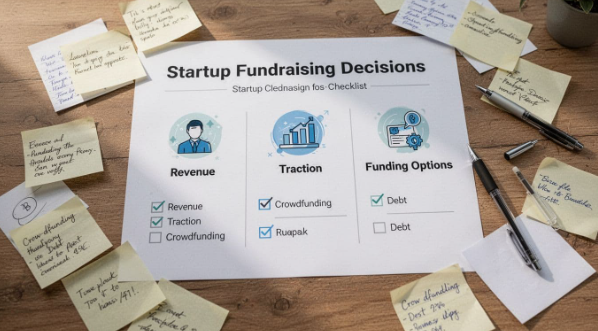
Checklist-style view of common fundraising decision factors, created with AI.
Think of funding as tools, not trophies. Each option trades off speed, risk, dilution (giving up ownership), and repayment pressure. In 2026, many founders stay bootstrapped longer, or they raise a small round and then push hard toward profitability.
Non-VC funding that fits bootstrapped companies (and when each one makes sense)
Here are four common options, plus when to avoid them:
- Friends and family: fast and flexible, but it can strain relationships. Avoid it if expectations aren’t written down.
- Customer revenue: the best money if you can get it, because it validates demand. Avoid discounting so deeply that customers become unprofitable.
- Equity crowdfunding: many small checks from supporters. Avoid it if you don’t want the time cost of updates and a larger cap table.
- Venture debt: a loan that must be repaid, often paired with warrants. Avoid it without predictable revenue and a clear payback plan.
For a plain-language overview of grants, debt, and other paths, see this breakdown on choosing alternative funding.
A practical decision checklist: should you raise now, or wait 90 more days?
If you can bootstrap for three more months, do it. Ninety days of traction can change your valuation, your investor list, and how much ownership you keep.
If your plan for new money doesn’t increase revenue soon, it’s probably just buying time.
Use this quick checklist before you start fundraising:
- Runway: do you have at least 4 to 6 months of cash left.
- Key hire need: will one hire (sales, product, or ops) unlock growth.
- Clear growth loop: do you know how customers reliably find and buy.
- Proven retention: are customers sticking around after the first month.
- Use-of-funds plan: can you explain what the money changes in 180 days.
This is also where “seed strapping” fits: raise a small round, then aim for profitability, not endless burn.
Fundraise like a bootstrapper: raise small, tell the truth, and protect your leverage
A bootstrapper’s advantage is optionality. You can walk away. That changes the whole conversation.
Raise the smallest amount that removes a real bottleneck, such as hiring a sales lead, financing inventory, or building one key integration. Stay selective, and avoid investors who back direct competitors. A fast yes isn’t worth it if it creates long-term conflicts.
Build a tight pitch that leads with customers, not hype
Keep your pitch simple and numeric. A clean flow works well: the problem, who pays, why you win, traction, business model, what you’ll do with the money, and the ask.
Three example traction lines you can adapt:
- “$18k MRR, 8% monthly growth, churn under 2%.”
- “42 paying teams, 65% gross margin, payback in 6 weeks.”
- “$6k MRR, retention at 90 days is 80%, growing via LinkedIn outbound.”
If your deck feels busy, this essay on why most startup decks fail early is a good reminder to lead with economics, not slides.
Run a focused investor process so you do not lose months to maybes
Fundraising expands to fill the time you give it. Prevent that by running a tight process: list 30 realistic investors, start with warm intros, then batch meetings into 2 to 3 weeks. After each call, send a short recap with metrics and one clear next step.
Set a decision deadline. Without one, you’ll collect “keep me posted” replies for months.
Protect your leverage by moving in batches, and by asking for a clear next step every time.
Watch for three risks: bad terms, too much dilution, and strategic investors with conflicts.
Conclusion
A startup bootstrapped fundraising strategy is not anti-investor. It’s pro-proof. First, earn early revenue and track a few simple metrics. Next, use non-VC options only when they fit your cash flow and risk tolerance. Then, if you raise, do it from strength with a small round and a clear plan.
This week, choose one channel and stick to it. Track MRR, retention, and payback. Set a 90-day traction goal before you book investor meetings. Traction is still the best negotiator in the room.